June 18, 2026 · Obsessed Living Research Team
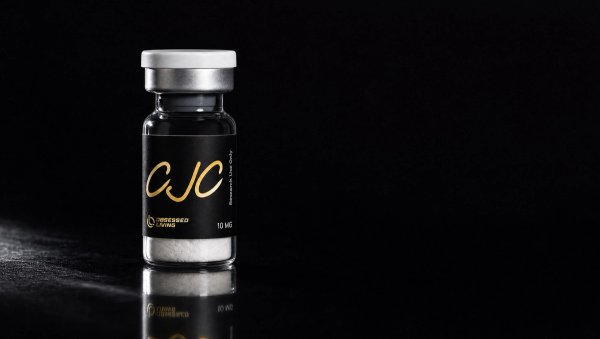
CJC-1295, the GHRH Receptor & Half-Life in Published Research
When researchers examine CJC-1295, two questions come up consistently: what does it do at the receptor level, and why does it remain detectable in plasma far longer than native GHRH? Here is what the pre-clinical and early clinical literature actually describes.
The GHRH receptor: what published research says about the signaling cascade
Growth-hormone-releasing hormone (GHRH) is a hypothalamic peptide that acts on a specific receptor — the GHRH receptor (GHRH-R) — expressed on pituitary somatotrope cells. The GHRH-R is a Class II (Secretin family) G-protein-coupled receptor coupled to stimulatory Gs proteins [1, 2].
Published reviews of the receptor's signaling cascade describe the following sequence of events in laboratory models:
- GHRH (or a GHRH analog) binds to the extracellular domain of GHRH-R on the pituitary somatotrope.
- Receptor activation triggers Gs-mediated stimulation of adenylyl cyclase, elevating intracellular cAMP.
- cAMP activates protein kinase A (PKA), which phosphorylates the transcription factor CREB.
- CREB-driven transcription promotes expression of the pituitary-specific transcription factor Pit-1, which drives GH gene expression.
- The same cAMP signal promotes calcium influx through voltage-sensitive channels, further stimulating GH secretion from secretory granules [1, 2].
It is the activation of this cascade that researchers study when evaluating GHRH analogs — including CJC-1295 — in laboratory models.
Why native GHRH has a short plasma half-life
Native hGRF(1-44) and its shorter active fragment hGRF(1-29) are both rapidly degraded by circulating serine proteases and dipeptidyl peptidase IV (DPP-IV). The plasma half-life of unmodified GHRH in humans is measured in minutes [3]. This rapid clearance limits its utility in sustained experimental protocols, which is the research rationale for engineering longer-acting analogs.
How CJC-1295's molecular modifications extend half-life in research models
CJC-1295 is a tetra-substituted variant of hGRF(1-29) carrying an added maleimidopropionic acid (MPA) group at its C-terminus [4, 5]. Published research describes this design as a "Drug Affinity Complex" (DAC) approach: after subcutaneous administration, the MPA group reacts with free thiol groups on circulating albumin, forming a covalent, slowly-reversing conjugate that effectively uses albumin's long half-life (~19 days) as a depot reservoir [4].
A preclinical study in rats confirmed that hGRF(1-29)-albumin bioconjugates retained the capacity to activate the GHRH receptor on anterior pituitary cells, demonstrating that the albumin-binding modification did not abolish receptor binding affinity in that model [4]. The study identified CJC-1295 specifically as the compound exhibiting this long-lasting GRF-analog profile.
What pharmacokinetic studies have reported
A Phase 1/2 dose-escalation study in healthy adult volunteers — one of the few published human pharmacokinetic trials of CJC-1295 — reported the following observations (all in a controlled research context, not clinical claims) [5]:
- After a single dose, mean plasma GH concentrations showed dose-dependent increases lasting 6 days or more.
- Mean plasma IGF-1 concentrations were elevated for 9–11 days after a single administration.
- With multiple doses, there was evidence of cumulative GH and IGF-1 elevations, suggesting that repeat dosing in experimental protocols may produce compounding pharmacodynamic responses.
- The authors estimated a mean apparent half-life consistent with the albumin-binding hypothesis — substantially longer than native GHRH.
A separate animal-model study examined once-daily administration of CJC-1295, focusing on whether a sustained plasma concentration disrupted the pulsatile pattern of GH secretion — a parameter important to researchers studying the hypothalamic-pituitary axis. That study reported that pulsatile secretion was maintained in the model examined [6].
What this does not tell us
All of these findings come from controlled preclinical models and small-n early-phase pharmacokinetic studies in healthy volunteers. They describe pharmacokinetic and pharmacodynamic observations in research settings. None of them establish what CJC-1295 does in disease states, and none are the basis for clinical dosing recommendations in humans. The compound is not an approved drug.
For the broader structural context — and how this receptor-binding profile compares to Sermorelin and Tesamorelin — see [CJC-1295 vs. Sermorelin vs. Tesamorelin](/blog/cjc-1295-vs-sermorelin-tesamorelin).
For the full research overview, see the [CJC-1295 research pillar](/research/cjc-1295).
The Obsessed Living Research Team summarizes peer-reviewed peptide research for educational, research-use reference. Content is not medical advice.