June 18, 2026 · Obsessed Living Research Team
CJC-1295 Research FAQ: Common Questions Answered in a Research Context
The questions below reflect what researchers and informed readers typically ask when first engaging with the CJC-1295 literature. All answers stay in a research register: they describe what published studies have investigated, not what the compound does for a person.
What is CJC-1295?
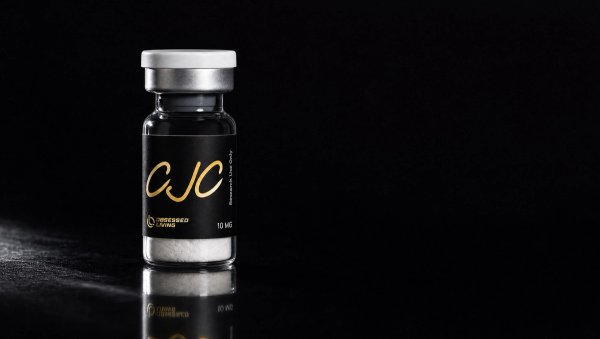
CJC-1295 is a synthetic 30-amino-acid peptide analog of growth-hormone-releasing hormone (GHRH). It is derived from the first 29 residues of human GRF (hGRF[1-29]) with four amino acid substitutions and an added maleimidopropionic acid (MPA) reactive group at its C-terminus [1, 2]. This structure is studied for its capacity to bind to plasma albumin after administration — a property that published research describes as substantially extending the compound's plasma half-life compared with native GHRH [1, 2].
CJC-1295 is supplied for laboratory research use only. It is not for human consumption.
How does CJC-1295 differ from native GHRH?
Native GHRH (hGRF[1-44] or its active fragment hGRF[1-29]) is rapidly degraded by serine proteases and DPP-IV in plasma, giving it a plasma half-life measured in minutes [3]. CJC-1295 is engineered to avoid this rapid clearance: its four amino acid substitutions confer protease resistance, and its MPA group covalently links to free thiol groups on circulating albumin, creating a slowly-releasing depot [2]. Published preclinical work confirmed that albumin-bound hGRF(1-29) conjugates retained the ability to activate the GHRH receptor (GHRH-R) on anterior pituitary cells in rat models [2].
What is the GHRH receptor and how does CJC-1295 interact with it in research models?
The GHRH receptor (GHRH-R) is a Class II (Secretin family) G-protein-coupled receptor expressed on pituitary somatotrope cells. When GHRH or a GHRH analog binds the receptor, it activates Gs-coupled adenylyl cyclase, elevating intracellular cAMP, which in turn activates protein kinase A (PKA) and the transcription factor CREB, promoting GH gene expression and secretion from the pituitary [4, 5]. CJC-1295, as a GHRH analog, is studied in terms of whether it engages this same cascade while its albumin-binding properties modify its pharmacokinetic profile.
What have pharmacokinetic studies of CJC-1295 observed?
The most frequently cited CJC-1295 human pharmacokinetic study is a Phase 1/2 dose-escalation trial in healthy adults [1]. Published observations from that study included:
- Dose-dependent increases in mean plasma GH concentrations lasting 6 or more days after a single administration.
- Mean plasma IGF-1 concentrations elevated for 9–11 days after a single administration.
- Evidence of cumulative GH and IGF-1 elevations with repeated dosing.
A separate study examined once-daily CJC-1295 administration in an animal model and characterized the relationship between sustained plasma levels and pulsatile GH secretion patterns [6].
These are pharmacokinetic/pharmacodynamic observations in controlled research settings — not clinical efficacy or safety claims.
How does CJC-1295 compare to Sermorelin?
Sermorelin is a 29-amino-acid analog of GHRH (specifically hGRF[1-29]NH₂ — similar in length to CJC-1295's core sequence but without the DAC modification). Published literature describes Sermorelin as the shortest synthetic GHRH fragment retaining full biological activity at the GHRH-R [7]. Because Sermorelin lacks the albumin-binding group, its plasma half-life is substantially shorter than CJC-1295's — making the two compounds structurally analogous in receptor target but distinct in pharmacokinetic profile. Both have been studied in the context of GH-axis stimulation, but in different experimental settings with different protocols. For a full structural comparison, see [CJC-1295 vs. Sermorelin vs. Tesamorelin](/blog/cjc-1295-vs-sermorelin-tesamorelin).
How does CJC-1295 compare to Tesamorelin?
Tesamorelin carries the full 44-residue GHRH sequence with a trans-3-hexenoic acid modification at the N-terminus. It is the only FDA-approved drug in the GHRH-analog class, indicated specifically for reduction of excess abdominal fat in HIV-infected patients with lipodystrophy — a specific, regulatory-reviewed indication backed by Phase 3 randomized controlled trials [8, 9]. CJC-1295 has no approved clinical indication. Its published evidence base consists primarily of early-phase pharmacokinetic studies in healthy volunteers and preclinical animal-model work, which is a materially different evidentiary context from Tesamorelin's approved use.
Is CJC-1295 the same as "CJC-1295 with DAC"?
In the analytical and anti-doping literature, "CJC-1295 with DAC" refers to CJC-1295 as described in this document — the compound carrying the Drug Affinity Complex (DAC/MPA) modification that enables albumin binding. There is also a compound sometimes called "CJC-1295 without DAC" or "Modified GRF(1-29)" in some commercial contexts, which is the tetra-substituted hGRF(1-29) peptide without the albumin-reactive group. These are structurally distinct compounds. Peer-reviewed detection methodology literature specifically distinguishes them in analytical assays [10]. Researchers should verify which specific compound their reference materials correspond to.
What does the research literature say about ipamorelin in this context?
Ipamorelin is a growth hormone secretagogue (GHS) that acts through the ghrelin receptor (GHS-R1a) rather than the GHRH-R — a mechanistically distinct pathway [11]. Some research contexts examine GHRH analogs and GHS-R agonists together because they act synergistically on GH secretion, but they are structurally unrelated compound classes targeting different receptors. Published literature distinguishes these pathways clearly; any research protocol combining them addresses two separate receptor mechanisms.
How is CJC-1295 characterized analytically in research?
Because CJC-1295 has been of interest in anti-doping research (particularly in equine sports), several peer-reviewed analytical methods have been developed and published to detect it in biological matrices. These include an immunoPCR screening assay capable of detecting CJC-1295 and other GHRH analogs in equine plasma [10], and an LC-MS/MS confirmatory method for CJC-1295 in equine plasma samples [12]. This body of analytical work provides well-characterized reference methodology for researchers working with the compound.
Where can I read the primary literature?
Key peer-reviewed papers are linked in the [CJC-1295 research pillar](/research/cjc-1295) and throughout the spokes. The primary pharmacokinetic study is available at PubMed PMID 16352683. The albumin-binding mechanism study is at PMID 15817669. The GHRH-R signaling review is at PMC12137518.
The Obsessed Living Research Team summarizes peer-reviewed peptide research for educational, research-use reference. Content is not medical advice.