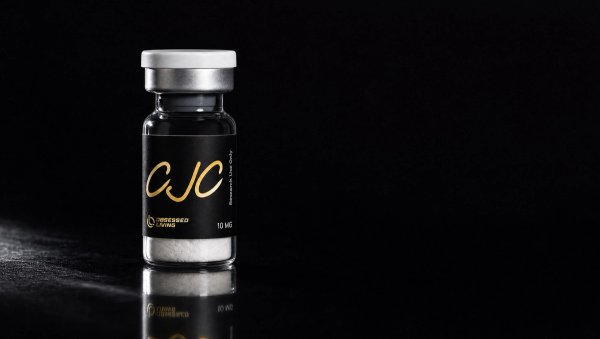
June 18, 2026 · Obsessed Living Research Team
CJC-1295 vs. Sermorelin vs. Tesamorelin: What the Research Compares
Three synthetic peptides appear repeatedly in the GHRH-analog research literature: CJC-1295, Sermorelin, and Tesamorelin. All three share the same target — the GHRH receptor (GHRH-R) on pituitary somatotrope cells — but differ substantially in their primary sequence length, structural modifications, plasma half-life, and the research contexts in which each has been most extensively studied. Here is what the published literature describes.
Common ground: all three are GHRH-receptor agonists
Published reviews confirm that all three compounds act as agonists at the GHRH-R, a Class II G-protein-coupled receptor that, when activated, drives cAMP-mediated GH synthesis and secretion from the pituitary [1, 2]. Unlike exogenous recombinant human GH (rhGH), which bypasses the pituitary entirely, GHRH analogs work upstream — stimulating the pituitary's own secretory machinery.
A review examining growth hormone secretagogues noted that both Sermorelin and Tesamorelin mimic GHRH and act as GHRH-R agonists, while also noting that pulsatile GH secretion patterns differ between GHRH-stimulated pathways and ghrelin/GHS-R pathways [1]. CJC-1295 operates through the same GHRH-R axis.
Structural differences: what the chemistry looks like
Compound | Sequence Length | Key Structural Feature | Published Half-Life Context
Sermorelin — 29 amino acids (hGRF[1-29]NH₂); Shortest fully active GHRH fragment; amidated C-terminus; Short (minutes); mirrors native GHRH
Tesamorelin — 44 amino acids (full hGRF[1-44]); Trans-3-hexenoic acid conjugation at N-terminus for protease resistance; Moderately extended vs. native GHRH
CJC-1295 — 30 amino acids (tetra-substituted hGRF[1-29]); Maleimidopropionic acid (MPA/DAC) group; covalent albumin binding; Substantially extended; days [3, 4]
Sermorelin was characterized in published research as the shortest synthetic peptide retaining full biological activity of GHRH [5]. Its 29-residue sequence corresponds to the minimum active fragment, and its relatively rapid clearance makes it useful as a research tool for short-duration GHRH-axis stimulation experiments.
Tesamorelin carries the full 44-residue GHRH sequence but with a trans-3-hexenoic acid modification at the N-terminus, a change published literature describes as conferring increased resistance to enzymatic degradation relative to unmodified hGRF(1-44) [6]. This structural feature is part of the rationale for studying Tesamorelin in contexts requiring sustained receptor engagement.
CJC-1295 takes a different approach to half-life extension: rather than modifying the peptide backbone for protease resistance, it adds a reactive group that forms a covalent bond with circulating albumin after administration, using albumin's long half-life as an endogenous depot [3, 4].
What research contexts has each been studied in?
The three compounds have been investigated in notably different research settings, which reflects their structural profiles:
Sermorelin
Published literature has investigated Sermorelin in the context of GH axis provocative testing and GH deficiency in pediatric populations. A review in the drug literature describes it as a well-tolerated GHRH analog studied for stimulating GH secretion from the anterior pituitary in both diagnostic and potential therapeutic research contexts [5]. Sermorelin has also been reviewed in the context of adult-onset GH insufficiency as a research comparator to rhGH [2].
Tesamorelin
Tesamorelin has the most developed clinical-trial dataset of the three compounds discussed here, because it is the only FDA-approved drug in this structural class — indicated specifically for the reduction of excess abdominal fat in HIV-infected patients with lipodystrophy. Published randomized controlled trials (Phase 3) reported that Tesamorelin significantly decreased visceral adipose tissue (VAT) in this specific patient population after 26 weeks, with effects that were not maintained after discontinuation [6, 7, 8]. A 2025 meta-analysis of randomized controlled trials confirmed these findings across five included trials [9].
It is important to frame this accurately: Tesamorelin's approved indication is a specific, well-defined clinical population (HIV-associated lipodystrophy). Research outside of that indication, or with other GHRH analogs, does not carry the same evidentiary weight.
CJC-1295
CJC-1295 has been studied primarily in early-phase pharmacokinetic and pharmacodynamic research in healthy adult volunteers, with the key published study reporting dose-dependent GH and IGF-1 elevations over multi-day periods [3]. Animal-model work established the albumin-binding mechanism and GHRH-receptor activation profile [4]. CJC-1295 does not have an approved clinical indication. Its research literature is accordingly more limited than Tesamorelin's, and the compound's extended half-life characteristics are studied as a pharmacological phenomenon rather than a clinical outcome.
How researchers differentiate them analytically
A review article on the detection of synthetic GHRH analogs in biological matrices specifically discussed CJC-1295, Sermorelin, and Tesamorelin as a group, noting the development of analytical methods (including immunoPCR and LC-MS/MS assays) to distinguish them in equine and human plasma [10, 11]. This analytical differentiation work itself reflects the three compounds' distinct structural characteristics.
What this comparison does not tell us
Structural and pharmacokinetic differences between research compounds do not translate directly into comparative clinical recommendations. The three analogs work at the same receptor but have been studied in different populations, using different protocols, with different levels of regulatory scrutiny. None of this literature supports ranking one compound over another for human use outside of approved indications.
For the full mechanistic background on CJC-1295 specifically, see [CJC-1295, the GHRH Receptor & Half-Life in Published Research](/blog/cjc-1295-ghrh-receptor).
For the full research overview, see the [CJC-1295 research pillar](/research/cjc-1295).
The Obsessed Living Research Team summarizes peer-reviewed peptide research for educational, research-use reference. Content is not medical advice.