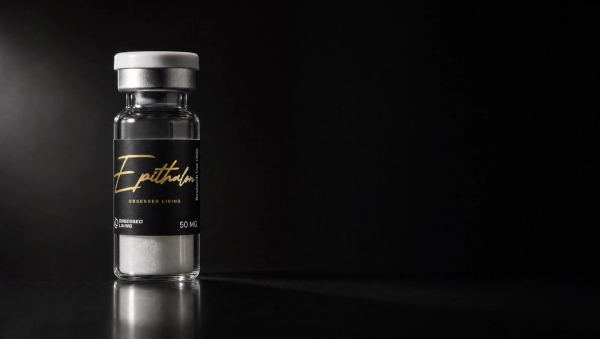
June 18, 2026 · Obsessed Living Research Team
Epithalon Research FAQ
Frequently Asked Questions
What is Epithalon?
Epithalon (also written Epitalon; systematic name Ala-Glu-Asp-Gly, abbreviated AEDG) is a synthetic tetrapeptide — a chain of four amino acids — whose sequence was identified within the polypeptide complex of the bovine pineal gland and subsequently synthesized for laboratory investigation. It is not an approved drug. It is supplied for research use only and is not for human consumption.
What does Epithalon research study?
Published research has investigated Epithalon in the context of two primary areas: (1) telomerase enzyme activity and telomere biology in cell-culture models, and (2) pineal gland melatonin secretion and circadian clock-gene signaling in animal models and small human-subject studies. Research has also explored in-vitro chromatin activity and gene expression during neurogenesis.
Does Epithalon extend telomeres?
Published cell-culture studies have reported that exposure to Epithalon in vitro was associated with measurable telomerase activity and telomere length changes in specific cell lines. A 2003 study (PMID: 12937682) reported telomerase induction in human fetal fibroblasts; a 2025 study (PMID: 40908429) examined multiple human cell lines and reported similar findings, with a correction subsequently published (PMID: 41240216). These are in-vitro findings — observations in cells in a laboratory dish. They do not establish that Epithalon extends telomeres in living humans, and no controlled human clinical trial has examined this question. In-vitro telomerase activity is not equivalent to human health benefit.
Has Epithalon been studied in humans?
A small number of studies — primarily from the St. Petersburg Institute of Bioregulation and Gerontology — have included human subjects. These investigated melatonin levels in elderly individuals and circadian clock-gene expression in people with documented reduced pineal function. The sample sizes are small, study designs do not meet current randomized-controlled-trial standards, and the research has not been independently replicated at the scale needed to draw clinical conclusions. Human data for Epithalon is very limited.
Who produced most of the Epithalon research?
The large majority of the Epithalon literature was produced by a single institutional group: the St. Petersburg Institute of Bioregulation and Gerontology, principally V.K. Khavinson and colleagues. This concentration is notable and is acknowledged in published reviews of the compound [ref: PMC11943447]. Independent replication from unaffiliated groups is sparse; the 2025 Al-dulaimi et al. cell-culture study (PMID: 40908429) is among the few published works from a different research team.
What is the relationship between Epithalon and the pineal gland?
Epithalon's sequence was identified within the natural polypeptide complex of the pineal gland (PMID: 29124531). Published animal and small human-subject studies have investigated whether administration of Epithalon (or the related extract, Epithalamin) is associated with changes in nighttime melatonin secretion in aged subjects with documented pineal functional decline. These studies reported associations; they do not establish Epithalon as a therapeutic agent for pineal function or circadian rhythm disorders.
What does "research use only" mean?
"Research use only" means that Epithalon, as supplied by research-material vendors, is intended for laboratory investigation — cell-culture experiments, in-vitro assays, and controlled pre-clinical research. It is not formulated, tested, approved, or regulated for administration to humans. The designation "not for human consumption" reflects both the regulatory reality (no approved indication) and the stage of the science (pre-clinical / very limited human data).
Is Epithalon the same as Epithalamin?
No. Epithalamin is a complex polypeptide fraction extracted from bovine pineal glands — it contains many peptides and bioactive molecules. Epithalon is the synthetic tetrapeptide (AEDG) derived from the sequence identified within Epithalamin. Researchers synthesized Epithalon to allow controlled laboratory study of a defined, single compound rather than a complex mixture. The two are related in origin but are chemically distinct.
What is the quality of the Epithalon evidence base overall?
Thin, concentrated, and preliminary. The evidence base is dominated by one research group, uses animal models and cell culture for most studies, has very limited well-controlled human data, and has not been replicated independently to the standard required to draw clinical conclusions. The telomerase and circadian-signaling research is scientifically interesting as a basis for further investigation. It does not support the anti-aging or lifespan-extension claims commonly made about Epithalon in popular and marketing contexts.
For the full research overview, see the [Epithalon research pillar](/research/epithalon).
The Obsessed Living Research Team summarizes peer-reviewed peptide research for educational, research-use reference. Content is not medical advice.