June 18, 2026 · Obsessed Living Research Team
GHK-Cu Research FAQ
These questions and answers are written in a research register only. GHK-Cu is supplied for laboratory research purposes. It is not for human consumption, and nothing here constitutes medical or health advice.
What is GHK-Cu?
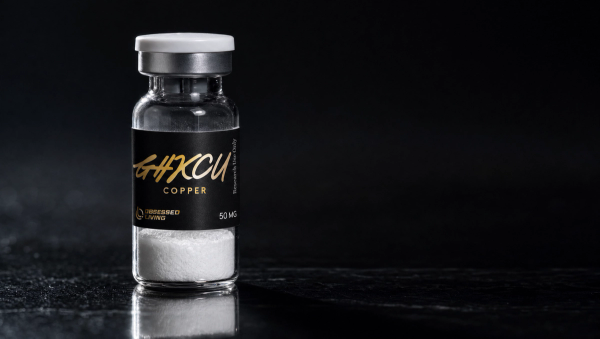
GHK-Cu is the copper(II) complex of the tripeptide glycyl-L-histidyl-L-lysine (GHK). The tripeptide occurs naturally in human plasma, saliva, and urine. Researchers have studied it since the 1970s, initially in the context of its copper-binding affinity and subsequently in wound biology, fibroblast cell culture, and gene-expression analyses. As a research compound, it is supplied as a lyophilized powder for in-vitro investigation. It is not an approved drug and is not for human consumption.
Why does GHK need copper to be studied the way it is?
Studies have found that some of the cellular observations associated with GHK-Cu complex cannot be reproduced by the unbound tripeptide GHK alone — copper ions appear to be required for certain effects measured in cell-culture models [1]. The histidine residue in the GHK sequence provides the primary Cu²⁺ coordination site, and research proposes that the peptide functions as a copper carrier in laboratory tissue models: it binds copper with high affinity and is proposed to modulate its local availability at cell surfaces [2].
What has research specifically investigated regarding GHK-Cu and extracellular matrix?
Published studies have examined GHK-Cu in several ECM contexts. In fibroblast culture experiments, researchers reported concentration-dependent stimulation of collagen synthesis [3] and stimulation of sulfated glycosaminoglycan production [2]. In-vivo wound-chamber experiments in rat models reported concentration-dependent increases in connective tissue accumulation in wounds [4]. Researchers have also investigated GHK-Cu in the context of MMP/TIMP regulation — one study reported simultaneous upregulation of MMP-2 and its inhibitors TIMP-1 and TIMP-2 in cultured fibroblasts [1]. These are specific laboratory-model observations, not validated clinical findings.
What does the MMP/TIMP research actually mean?
Matrix metalloproteinases (MMPs) are enzymes that degrade components of the extracellular matrix; their tissue inhibitors (TIMPs) regulate this process. The dual observation — GHK-Cu increasing both MMP-2 and TIMP-1/TIMP-2 simultaneously in cell cultures — is described in the research literature as consistent with a remodeling-regulation pattern rather than straightforward tissue breakdown or synthesis [2]. Investigators have framed this as evidence that GHK-Cu modulates turnover dynamics in ECM biology laboratory models. What this means in a human physiological context has not been established through clinical trials.
Has GHK-Cu been studied in gene-expression analyses?
Yes. Reviews compiling gene-array and expression-profiling data report that GHK (with and without copper) appears to modulate a large set of genes in cell-culture models, including genes associated with TGF-β pathway signaling, antioxidant programs, tissue remodeling, and anti-inflammatory cascades [5]. One analysis noted modulation of MMP1, MMP2, and TIMP1 at nanomolar concentrations in laboratory models. These gene-expression findings are observations from in-vitro experimental systems; they identify candidates for further study rather than establish clinical outcomes.
How does GHK-Cu differ structurally from palmitoyl peptides like Pal-GHK or Pal-KTTKS?
GHK-Cu is the native tripeptide coordinated with copper(II). Palmitoyl peptides are modified versions of peptide sequences in which a fatty acid chain (palmitic acid) is covalently attached to increase lipophilicity. Pal-GHK is the palmitoylated form of the same GHK sequence — researchers have studied it alongside GHK-Cu to compare skin-permeation behavior in in-vitro models, with results suggesting different penetration profiles for each modification [6]. Pal-KTTKS is a structurally unrelated ECM-fragment sequence with a different proposed mechanism (matrikine signaling rather than copper delivery). For a fuller comparison, see the [GHK-Cu vs skin peptides spoke](/blog/ghk-cu-vs-skin-peptides).
Is there human clinical data on GHK-Cu?
Human data is limited. A small number of topical studies have examined GHK-Cu formulations on human skin, but these studies are typically small in sample size, short in duration, and focused on specific end-points such as skin texture or wrinkle assessment in a cosmetic context. A 2025 review of topically applied GHK notes that published information on skin permeability, effectiveness, and physicochemical properties in humans remains insufficient, and identifies this as a gap in the literature [7]. The compound is not an approved drug, and large-scale clinical trials establishing safety or efficacy profiles in humans are not available.
What models have been used in GHK-Cu research?
The literature uses several research systems: (1) in-vitro fibroblast cultures — human or animal-derived cells grown in media and exposed to GHK-Cu to measure effects on protein synthesis, gene expression, and enzyme activity; (2) in-vivo rat wound-chamber models — surgically implanted chambers allowing collection of wound fluid and tissue for biochemical analysis; (3) ex-vivo skin samples — excised human skin used to study permeation and peptide distribution; and (4) animal pulmonary models — used in studies investigating oxidative stress pathway responses [8]. Each model has different translational implications and different distances from human physiology.
Are there studies comparing GHK-Cu alongside hyaluronic acid?
Yes. A published study examined GHK-Cu in combination with hyaluronic acid in fibroblast cultures and ex-vivo skin, reporting upregulation of collagen IV expression in those model systems [9]. The researchers described a synergistic profile between the two compounds in their specific experimental design. This is a cell-culture and ex-vivo study; it does not establish what the combination does in a human being.
Where can I learn more about GHK-Cu research?
- GHK-Cu Research Overview (Pillar) — full overview of structure, studied pathways, and the state of the literature.
- GHK-Cu: Mechanism in Published Studies — deeper dive into the molecular pathways.
- GHK-Cu vs Other Skin Peptides — how the research literature compares GHK-Cu with related compounds.
- GHK-Cu Research Materials — research-grade supply information.
The Obsessed Living Research Team summarizes peer-reviewed peptide research for educational, research-use reference. Content is not medical advice.