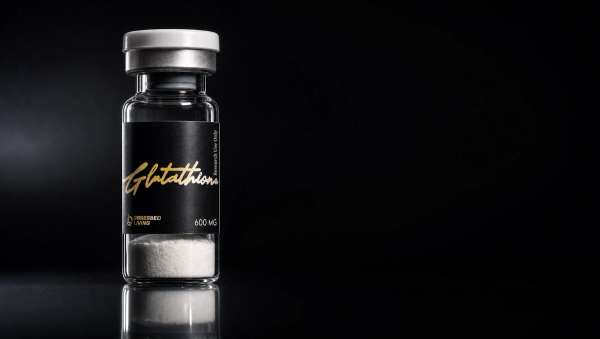
June 18, 2026 · Obsessed Living Research Team
Glutathione Research FAQ: Common Questions Answered in a Research Context
What is Glutathione, chemically?
Glutathione (GSH) is an endogenous tripeptide with the sequence γ-L-glutamyl-L-cysteinyl-glycine. It is the most abundant low-molecular-weight thiol synthesized in cells, present at millimolar intracellular concentrations in most mammalian cell types studied in the literature [1]. The defining structural feature is the gamma-peptide bond linking glutamate to cysteine — an unusual linkage (at the side-chain carboxyl rather than the alpha-carboxyl) that makes GSH resistant to cleavage by common intracellular proteases.
What does the GSH/GSSG ratio represent in published research?
The GSH/GSSG ratio is the primary laboratory readout used to characterize the redox state of a cell preparation. Under steady-state conditions in cell-culture models, the ratio is typically 100:1 or greater (predominantly reduced GSH). When researchers expose cell cultures to elevated reactive oxygen species (ROS), GSH is consumed and GSSG accumulates — the ratio decreases, sometimes to 10:1 or below in acute oxidative-challenge models [2]. Published studies use this ratio as an index of oxidative load in controlled laboratory systems. It is a biochemical measurement in an experimental context, not a clinical diagnostic.
What enzymes does the published literature associate with GSH?
Three major enzyme families appear repeatedly in the GSH research literature:
- Glutathione peroxidases (GPx): Reduce hydrogen peroxide and lipid hydroperoxides using GSH as an electron donor, yielding GSSG as a byproduct [3].
- Glutathione reductase (GR): Recycles GSSG back to GSH using NADPH, linking the thiol system to the pentose-phosphate pathway [2].
- Glutathione S-transferases (GST): A large superfamily of phase-II enzymes that catalyze GSH conjugation to electrophilic substrates in xenobiotic metabolism studies [4].
What is glutamate-cysteine ligase (GCL) and why does the literature focus on it?
GCL (also called γ-glutamylcysteine synthetase) catalyzes the first and rate-limiting step in GSH biosynthesis: the ATP-dependent ligation of L-glutamate and L-cysteine to form γ-L-glutamyl-L-cysteine [1]. It is rate-limiting for two reasons studied in the literature: first, cysteine is the scarcer of the two substrates; second, GCL is subject to feedback inhibition by GSH itself. When GSH is abundant, GCL is partially inhibited; when GSH falls, inhibition is relieved. This regulatory mechanism has been characterized in enzyme-kinetic and cell-transfection studies.
Why does the literature characterize cysteine as the rate-limiting precursor?
Because intracellular cysteine concentrations are typically low and tightly regulated, while glutamate and glycine are generally present in excess [1]. Cysteine is cytotoxic at high concentrations, which constrains its intracellular accumulation. The EAAC1 transporter (Excitatory Amino Acid Carrier 1), also studied as a neuronal cysteine transporter, is one mechanism the literature has examined in relation to intracellular cysteine supply and GSH status in neuronal cell models [2].
How do researchers compare direct GSH to N-acetylcysteine (NAC) in laboratory studies?
NAC is a cysteine prodrug: after cellular uptake, it is hydrolyzed to release L-cysteine, which enters the GCL-catalyzed pathway to produce GSH endogenously. A published comparative study measured plasma GSH levels, GSH/GSSG ratios, and other oxidative stress markers after administering NAC, oral GSH, and sublingual GSH in an experimental setting, characterizing differences in measurable biomarkers across conditions [5]. The literature treats these as biochemically distinct strategies for modulating GSH in experimental models — not as interchangeable compounds for a health purpose.
What are glutathione S-transferases (GSTs) and how does the literature characterize their role?
GSTs are a superfamily of phase-II detoxification enzymes that catalyze the S-conjugation of GSH to electrophilic compounds — including reactive metabolites of xenobiotics and endogenous oxidized lipids. The conjugated products are generally more water-soluble and targeted for cellular export [4]. Published biochemistry has characterized GSTs across multiple structural classes (alpha, mu, pi, theta, omega, zeta in cytosolic isoforms), each with distinct substrate preferences. Research has also examined GST expression patterns across cell lines, noting overexpression in certain experimental tumor models — a subject of mechanistic interest in cancer cell biology research.
Does the published literature distinguish cytoplasmic and mitochondrial GSH pools?
Yes. The literature consistently notes that mitochondria cannot synthesize GSH and must import it from the cytoplasm via inner-membrane carriers [2]. Researchers have studied the mitochondrial GSH pool separately because mitochondria are a major site of ROS generation in cell metabolism, and experimental depletion of mitochondrial GSH in cell-culture models has been used to probe the relationship between mitochondrial redox state and cell-viability endpoints in vitro. These are controlled laboratory model observations.
What is S-glutathionylation and what does the literature say about it?
S-glutathionylation is the reversible post-translational modification of protein cysteine residues by GSH — forming a mixed disulfide between the protein thiol and the cysteine of GSH. The published literature has examined this modification as a potential mechanism of redox signaling: changes in the GSH/GSSG ratio may regulate specific protein functions in cell models by altering the glutathionylation status of cysteine residues at enzyme active sites or signaling domains [6]. This is an active area of mechanistic research in cell biology.
Where can I read the primary literature on Glutathione research?
The most directly relevant published sources are listed in the references below. PubMed (pubmed.ncbi.nlm.nih.gov) and PubMed Central (pmc.ncbi.nlm.nih.gov) are the primary databases. The [Glutathione research overview](/research/glutathione) indexes the key references used across this cluster.
The Obsessed Living Research Team summarizes peer-reviewed peptide research for educational, research-use reference. Content is not medical advice.