June 18, 2026 · Obsessed Living Research Team
Ipamorelin Research FAQ
The following questions are answered strictly within a research framing. All statements reflect what published pre-clinical and laboratory studies have investigated — not what Ipamorelin does in humans, and not guidance for any use.
Research use only. Not for human consumption.
What is Ipamorelin?
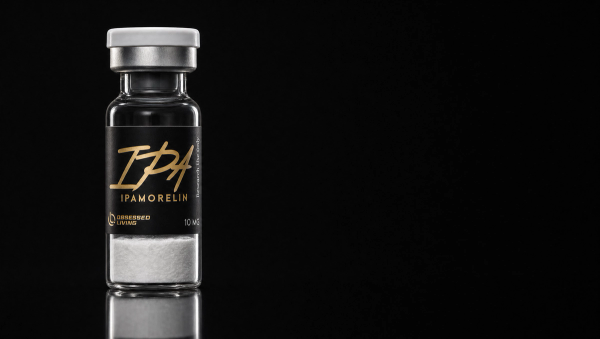
Ipamorelin is a synthetic pentapeptide — five amino acids — that has been studied in the published literature as an agonist at the ghrelin/GHSR-1a receptor and as a growth hormone secretagogue (GHS). It was characterized in the peer-reviewed literature in the late 1990s, where it was described as "the first selective growth hormone secretagogue" due to its pharmacological profile in animal assays [1]. It is not a drug, is not approved for human use, and is supplied strictly for laboratory research.
What receptor does Ipamorelin target in research?
Published studies have investigated Ipamorelin as an agonist at the GHSR-1a receptor — the growth hormone secretagogue receptor type 1a, which is also the receptor through which ghrelin (a stomach-derived peptide hormone) acts [2]. Activation of GHSR-1a on pituitary somatotroph cells has been associated with GH release in laboratory models. The receptor is also expressed in gastrointestinal tissue, which is why some research has examined Ipamorelin in GI motility models as well.
How does Ipamorelin differ from GHRP-6 and GHRP-2 in the research literature?
The key distinction the research record draws concerns selectivity. Studies in animal models observed that GHRP-6 and GHRP-2 stimulated release of ACTH (and consequently cortisol) alongside GH in pre-clinical assays [3]. Ipamorelin was characterized as not producing the same co-stimulation of ACTH/cortisol at equivalent doses in those animal models, which is the basis for the "selective" designation in the original research [1].
There are also differences in pharmacokinetics: anti-doping research found that Ipamorelin is extensively metabolized and excreted as a combination of parent compound and metabolites, whereas GHRP-6 was largely excreted unchanged in the same controlled study [4].
These are pre-clinical and pharmacokinetic distinctions only — not clinical comparisons.
What is the difference between Ipamorelin and CJC-1295?
They act through different mechanisms and belong to different compound classes. Ipamorelin is a GHRP — it acts through the ghrelin/GHSR-1a receptor. CJC-1295 is a long-acting analog of GHRH (growth hormone-releasing hormone) — it acts through the GHRH receptor on pituitary somatotrophs, a distinct receptor from GHSR-1a [5]. The research literature treats them as mechanistically separate compounds, even though both have been investigated in the context of GH-axis pharmacology. No claims are made here about combining or stacking compounds.
Has Ipamorelin been studied for gastrointestinal motility?
Yes, in pre-clinical models. Because the GHSR-1a receptor is expressed in the gut, researchers have investigated Ipamorelin as a "ghrelin mimetic" in rodent models of gastrointestinal function. Studies in rodent postoperative ileus models examined its effects on gastric transit and colonic motility [6, 7]. These are animal model findings and do not establish human therapeutic efficacy.
What does "research use only" mean in this context?
It means the compound is supplied as a laboratory reagent for scientific investigation — cell culture, animal studies, assay development — under applicable research regulations. It is not manufactured, labeled, tested, or approved as a drug or dietary supplement for human consumption. Supplying it with that designation reflects the regulatory reality: Ipamorelin has not completed a clinical drug approval pathway in any major regulatory jurisdiction for therapeutic use.
Is there human data on Ipamorelin?
Very limited. The majority of the published literature on Ipamorelin consists of in-vitro assays and animal model studies. Review literature on GH secretagogues as a class consistently notes that few long-term, rigorously controlled human clinical trials have been conducted for GHRPs including Ipamorelin [8]. This is one reason why GH secretagogues occupy what the literature describes as a "regulatory grey zone" — preclinically interesting, but with limited human evidence.
What is the broader GH secretagogue research context?
GH secretagogues as a compound class have been studied for associations with GH pulsatility, lean body mass parameters, bone turnover markers, and GI motility in pre-clinical and limited clinical settings [8]. Ipamorelin is one member of that class. A review focused on body composition noted that GHS compounds including peptide secretagogues have been investigated in the context of hypogonadal males and metabolic syndrome, though the evidence base remains early-stage [9]. Research in this area is ongoing.
For the full research overview, see the [Ipamorelin research pillar](/research/ipamorelin).
The Obsessed Living Research Team summarizes peer-reviewed peptide research for educational, research-use reference. Content is not medical advice.