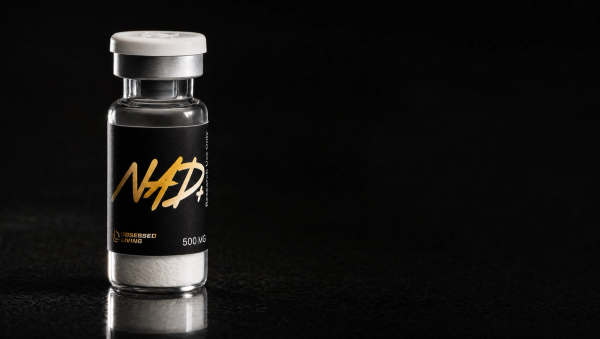
June 18, 2026 · Obsessed Living Research Team
NAD+ Research FAQ: Common Questions Answered in a Research Context
The following questions reflect what is commonly asked about NAD+ in a research context. Answers are drawn from published studies and reviews; they describe what the scientific literature has investigated, not what NAD+ does for any individual.
What is NAD+ and why does it appear in so much research?
NAD+ (nicotinamide adenine dinucleotide) is a dinucleotide coenzyme found in every living cell. It participates in redox reactions as an electron carrier (accepting electrons to become NADH) and serves as the co-substrate — and therefore gets consumed — by sirtuin deacylases and poly(ADP-ribose) polymerases (PARPs) [1]. Because it is at the center of both energy metabolism and regulatory signaling, changes in cellular NAD+ levels have broad downstream effects in laboratory models, which is why it appears across diverse areas of research from metabolic biology to aging science.
What is the NAMPT salvage pathway and why does research focus on it?
NAMPT (nicotinamide phosphoribosyltransferase) is the rate-limiting enzyme in the NAD+ salvage pathway — the primary route by which mammalian cells recycle nicotinamide to regenerate NAD+ [2]. Research focuses on this pathway because: (a) it accounts for the majority of NAD+ biosynthesis in most human tissues, and (b) it is the point where interventions with precursor compounds like NMN and NR are thought to feed into the pathway. Studies have also examined NAMPT in the context of DNA-damage responses, where NAD+ consumed by PARP1 must be resynthesized through salvage enzymes for cells to maintain energy balance [3].
What have studies observed about NAD+ and sirtuins?
Sirtuins (SIRT1–SIRT7) require NAD+ for every deacetylation reaction they catalyze. Laboratory research has found that sirtuin activity is sensitive to the availability of cellular NAD+. The most studied members in the context of mitochondria are SIRT1 (nuclear/cytoplasmic) and SIRT3 (mitochondrial). Published studies in animal and cell models have examined SIRT1-mediated regulation of PGC-1α and mitochondrial biogenesis programs, and SIRT3-mediated control of mitochondrial protein acetylation and reactive-oxygen-species balance [4, 5]. These are pre-clinical findings; the field continues to investigate how this axis functions in humans. See the full spoke: [NAD+, Sirtuins & Mitochondrial Function](/blog/nad-sirtuins-mitochondria).
What does the research say about NAD+ levels and aging?
A number of studies have reported that measured NAD+ concentrations are lower in aged tissues compared to young tissues across multiple model organisms and human tissue samples. Research has proposed several mechanisms: increased PARP activity in response to accumulated DNA damage, and activation of the NAD+-hydrolyzing enzyme CD38 via inflammatory signals secreted by senescent cells (the SASP) [6, 7]. However, a 2022 review cautioned that the evidence for a universal, linear NAD+ decline in human aging is not as settled as popular coverage suggests, noting variability across tissue types, measurement methods, and study designs [8]. The review describes the current situation as "universal truth or confounded consensus" — still an active area of inquiry.
What is the difference between NAD+, NMN, and NR in research?
NAD+ is the active coenzyme form. NMN (nicotinamide mononucleotide) and NR (nicotinamide riboside) are biosynthetic precursors that cells convert to NAD+ via salvage-pathway enzymes after uptake through specific transporters. Because NAD+ itself has limited membrane permeability in most physiological contexts, precursor compounds are often the preferred tool in animal studies. NR was characterized in a 2016 human pharmacokinetic study as orally bioavailable in both mice and humans [9]. NMN has been the subject of multiple human safety trials in the early 2020s, with studies generally reporting tolerability and dose-dependent changes in blood NAD+ metabolites [10]. For the detailed comparison, see: [NAD+ vs NMN vs NR: What the Precursor Research Compares](/blog/nad-vs-nmn-nr).
Have NAD+ precursors been tested in human clinical trials?
Yes. NR and NMN have both been evaluated in human trials, though the evidence base is still early-stage. Published trials have primarily examined safety, tolerability, and pharmacokinetics — that is, whether the compounds raise blood NAD+ metabolites and whether they are well-tolerated. A 2023 review of NMN human trials characterized it as safe and well-tolerated across disclosed studies while noting that effects on age-related physiological endpoints were mixed [10]. A meta-analysis of NAD+ precursor trials found some metabolic signals in specific populations but null effects in healthy individuals, and emphasized the need for longer, larger trials [11]. No NAD+ precursor compound is currently an approved drug for any indication.
What does "research use only" mean in this context?
It means the compound is supplied as a research reagent for use in laboratory, in-vitro, or pre-clinical investigations — not for administration to humans. Research-grade material is characterized for purity (via HPLC and a Certificate of Analysis) to ensure that what is being studied is well-defined. This designation is standard for compounds that have a body of pre-clinical literature but are not approved pharmaceutical agents.
For the full research overview, see [NAD+: Research Overview, Mechanism & Published Studies](/research/nad-plus).
The Obsessed Living Research Team summarizes peer-reviewed peptide research for educational, research-use reference. Content is not medical advice.