
Research Library · Obsessed Living Research Team
PT-141 (Bremelanotide): Research Overview, Receptor Pharmacology & Published Studies
What PT-141 is
PT-141, also known by its INN bremelanotide, is a synthetic cyclic heptapeptide — a ring-structured peptide composed of seven amino acids. It belongs to the melanocortin peptide family and is structurally derived from alpha-melanocyte-stimulating hormone (α-MSH), the naturally occurring neuropeptide produced by POMC (pro-opiomelanocortin)-expressing neurons [1, 2].
Unlike the linear α-MSH molecule, PT-141 is a cyclized, truncated analog, a modification that researchers note confers increased metabolic stability relative to the parent peptide [2]. The compound's molecular formula is C₅₀H₆₈N₁₄O₁₀, and its synthesis was explored as part of a broader program to develop stable melanocortin analogs with extended activity in controlled research settings [2, 3].
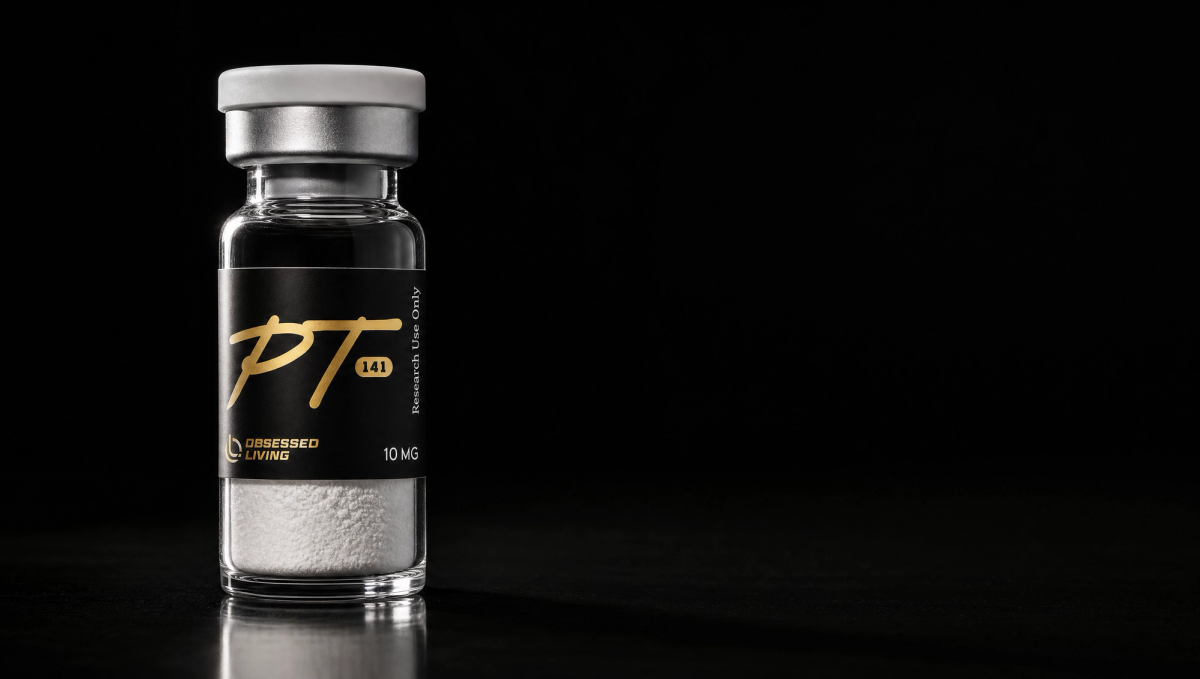
In a research context, PT-141 is typically supplied as a lyophilized (freeze-dried) powder for reconstitution and study. It is supplied for laboratory research use only and is not for human consumption.
The melanocortin receptor family — what published research has studied
PT-141's research profile is defined primarily by its interactions with the melanocortin receptor (MCR) system — a family of five G protein-coupled receptors (MC1R through MC5R). Published research characterizes PT-141 as an agonist at several of these subtypes, with particular focus on two centrally expressed receptors: MC4R and MC3R [1, 4].
A 2022 review in *Biomolecules* — "Ligands for Melanocortin Receptors: Beyond Melanocyte-Stimulating Hormones and Adrenocorticotropin" — provides a comprehensive description of the MCR ligand landscape, noting that among clinically studied compounds, bremelanotide represents one of the few melanocortin-based agents to have undergone rigorous investigation across multiple phases of formal research [4].
The MCR family is expressed broadly in the central nervous system, with particularly dense populations documented in hypothalamic and limbic structures. MC4R-positive neurons in the lateral hypothalamic area have been characterized in detail in neuroanatomical research, which mapped their peptide co-expression profiles, projection patterns, and responses to endogenous signaling molecules [5]. This neuroanatomical work provides the structural substrate against which MCR agonist pharmacology — including research on PT-141 — is interpreted.
Pathways published research has investigated
Published studies — conducted in laboratory animal models, cell-based assays, and formal clinical investigation — have examined PT-141 in the context of several mechanistic pathways. These are descriptions of what researchers have *studied*, not statements of human effects:
- MC4R and MC3R receptor binding. Early pharmacological characterization established PT-141 as an agonist at both MC4R and MC3R, receptors expressed predominantly in the central nervous system [1, 4]. A comprehensive review of MCR ligands situates PT-141 within the broader class of synthetic melanocortin agonists developed from α-MSH analogs [4].
- Central nervous system neuropeptide pathways. Preclinical work using animal models examined PT-141's interactions with limbic and hypothalamic circuitry, documenting the induction of immediate-early gene expression (Fos) in limbic and hypothalamic structures following peripheral administration, and measuring dopamine release in specific brain regions [6]. These findings were interpreted by researchers as evidence that PT-141 engages central neuropeptide pathways via MCR-mediated signaling.
- Melanocortin system genealogy. Historical reviews of the melanocortin peptide field describe how PT-141 emerged from a program that began with melanotan analogs — particularly melanotan II (MTII), a cyclic truncated α-MSH analog — and trace the pharmacological lineage from early melanocortin research through the development of cyclized, stabilized analogs such as PT-141 [3].
- MC4R-mediated signaling beyond its primary research context. More recent laboratory work has begun examining bremelanotide's interactions with MC3R and MC4R in oncological models, reporting that in glioblastoma cell cultures, MCR3 and MCR4 were identified as potential research targets, with bremelanotide-treated cells showing altered survivin expression and growth inhibition at concentrations not toxic to normal human cells [7]. These are early-stage, in-vitro findings.
The state of the literature
PT-141 / bremelanotide has a more extensive clinical research record than most research-grade peptides, having progressed through multiple phases of formal study. However, it is critical to characterize this record accurately within a research context:
- The compound's mechanism is understood at the receptor level — MCR agonism, particularly at MC4R and MC3R — but the downstream neuropeptide signaling cascades remain an active area of investigation [4, 6].
- Neuroanatomical research on MC4R circuitry has clarified where these receptors reside and how they integrate with other hypothalamic and limbic networks, providing the anatomical foundation for interpreting agonist pharmacology [5].
- Receptor pharmacology reviews note that bremelanotide non-selectively engages multiple MCR subtypes (MC1R through MC5R), a pharmacological profile that researchers must account for when designing studies [4].
- Emerging laboratory research — such as the glioblastoma cell work published in 2024 — suggests that melanocortin receptor biology extends into research areas that were not part of PT-141's original characterization [7].
The value of a research-framed discussion of PT-141 is precisely to situate these findings accurately: what the studies measured, in what models, and what remains unresolved.
How researchers handle it
In laboratory use, PT-141 is reconstituted from lyophilized powder, typically with bacteriostatic water, under standard aseptic research conditions. Material supplied for research should carry a Certificate of Analysis confirming HPLC-verified purity and confirmed peptide identity so that what is being studied is well-characterized.
Go deeper
- PT-141 and the Melanocortin Receptors (MC4R/MC3R) in Published Research — a detailed look at receptor pharmacology and the signaling pathways the literature has examined.
- PT-141 vs Other Melanocortin-System Peptides: What the Research Compares — how PT-141 relates to α-MSH, melanotan II, and setmelanotide in the melanocortin peptide literature.
- PT-141 Research FAQ — common questions about PT-141, answered in a research register.
Research materials
Related compound: PT-141 (Bremelanotide) — supplied as research-grade lyophilized powder with Certificate of Analysis. Research use only. Not for human consumption.
The Obsessed Living Research Team summarizes peer-reviewed peptide research for educational, research-use reference. Content is not medical advice. Our research standards.