
Research Library · Obsessed Living Research Team
Tesamorelin: Research Overview, Mechanism & Published Studies
What Tesamorelin is
Tesamorelin is a synthetic peptide composed of 44 amino acids — the full sequence of human growth-hormone-releasing hormone (GHRH), with a *trans*-3-hexenoic acid moiety conjugated to the tyrosine residue at the amino terminus [1, 2]. This structural modification was investigated specifically to improve resistance to enzymatic degradation in plasma; the serum enzyme dipeptidylaminopeptidase 4 (DPP-4) rapidly inactivates native GHRH, and the hexenoyl modification was shown in research to confer substantially greater stability [2, 3].
Because its amino-acid sequence mirrors the full-length GHRH(1-44) scaffold, Tesamorelin is studied as a high-fidelity ligand for the pituitary GHRH receptor, in contrast to shorter GHRH-fragment analogs. The compound has one narrow, well-characterized regulatory history: the U.S. Food and Drug Administration (FDA) approved Tesamorelin (brand name Egrifta) specifically and solely for the treatment of HIV-associated lipodystrophy (excess abdominal fat accumulation in people with HIV) [4]. That approval does not extend to weight management, general body composition, anti-aging, or any other indication.
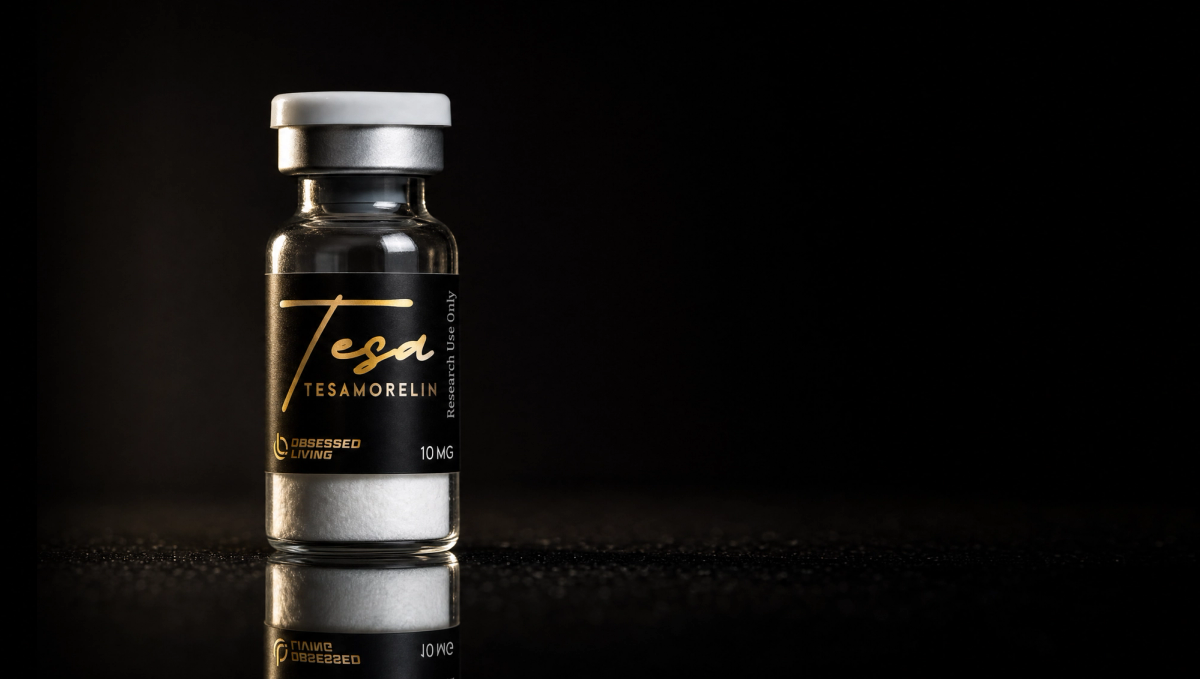
In a research context, Tesamorelin is supplied as a lyophilized (freeze-dried) powder. It is supplied for laboratory research use only and is not for human consumption.
Pathways published research has investigated
Published studies — including randomized controlled trials conducted in specific patient populations and pre-clinical mechanistic work — have investigated Tesamorelin in the context of several biological pathways. Importantly, these are descriptions of what researchers have *studied*, not statements of effect in healthy or general populations:
- GHRH-receptor binding and GH pulsatility. Research has established that Tesamorelin binds the pituitary GHRH receptor (a seven-transmembrane Gs-coupled receptor on somatotroph cells), triggering intracellular cAMP accumulation and the synthesis and pulsatile release of endogenous growth hormone [1, 3]. A study in healthy men found that once-daily Tesamorelin administration augmented both basal and pulsatile GH secretion over a two-week period, with IGF-1 rising significantly while markers of insulin sensitivity appeared preserved — a finding researchers have contrasted with the profile of exogenous recombinant GH [5].
- IGF-1 axis. Published work has documented that Tesamorelin-driven GH release stimulates hepatic production of insulin-like growth factor-1 (IGF-1), a downstream mediator of many GH-associated effects [1, 2]. The GHRH-receptor pathway preserves endogenous negative feedback: rising IGF-1 acts back on the pituitary to modulate further GH release, which researchers have cited as a theoretical safety distinction from direct GH administration [2].
- Visceral adipose tissue in HIV-associated lipodystrophy. Phase III trials conducted in adults with HIV and central adiposity (the population for which Tesamorelin received FDA approval) reported selective reductions in visceral fat over 26–52 weeks compared to placebo [4, 6]. These findings are specific to a defined clinical context and population — they describe what was observed in those trials, not a general effect on body composition.
- Hepatic lipid pathways in HIV-associated NAFLD. Separate research has investigated Tesamorelin in HIV-infected adults with nonalcoholic fatty liver disease (NAFLD), a population with 30–40% NAFLD prevalence. A randomized, double-blind, multicenter trial reported reductions in liver fat and findings related to fibrosis markers over one year in that specific population [7, 8].
- Cognitive and neurological correlates. Research teams have examined GHRH-analog administration (including Tesamorelin) in the context of cognitive testing and brain neurochemistry in adults with mild cognitive impairment and healthy older adults. One controlled trial reported that 20 weeks of GHRH-analog administration was associated with favorable scores on cognitive assessments in both groups [9]. A separate study used magnetic resonance spectroscopy to measure brain neurotransmitter levels in parallel with cognitive testing [10]. These are early, exploratory findings in specific populations — they are not evidence that Tesamorelin improves cognition.
The state of the literature
The Tesamorelin literature is more clinically developed than that of many research peptides, owing to its FDA-approved indication, which generated large Phase III trial data. However, that data is specific to adults with HIV-associated lipodystrophy — it does not extrapolate to healthy populations or other uses. For all other areas of investigation (cognitive correlates, general metabolic effects, non-HIV populations), the evidence base remains preliminary, and no regulatory body has approved Tesamorelin for those contexts.
This is exactly why research discussion of Tesamorelin must stay in the research register: "studies have investigated," "trials in HIV-positive adults reported," "researchers observed in that population" — rather than any claim about what the compound does for a person using it outside of studied contexts.
How researchers handle it
In laboratory use, Tesamorelin is reconstituted from lyophilized powder under standard research conditions. Material supplied for research should carry a Certificate of Analysis confirming identity and HPLC-verified purity.
Go deeper
- Tesamorelin, the GHRH Receptor & IGF-1 Axis in Published Research — a closer look at the specific signaling cascade above.
- Tesamorelin vs CJC-1295 vs Sermorelin: A Research-Framed Comparison — how these GHRH analogs differ structurally and in the literature. See also our CJC-1295 research overview.
- Tesamorelin Research FAQ — common questions, answered in a research context.
Research materials
Related compound: Tesamorelin — supplied as research-grade lyophilized powder with Certificate of Analysis. Research use only. Not for human consumption.
The Obsessed Living Research Team summarizes peer-reviewed peptide research for educational, research-use reference. Content is not medical advice. Our research standards.