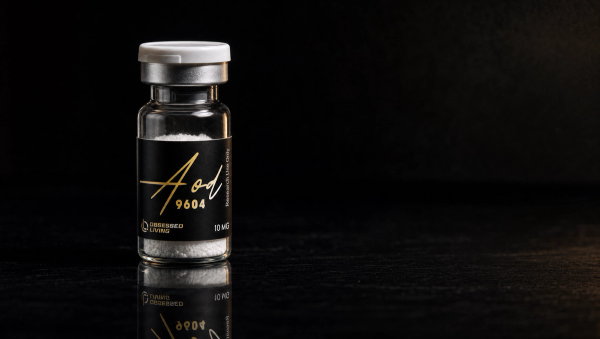
October 15, 2026 · Obsessed Living Research Team
AOD-9604 History: From a Growth Hormone Fragment to a Phase IIb Trial
Most research peptides arrive with a thin paper trail. AOD-9604 is different: it came out of a university laboratory, went through a commercial drug-development program with roughly 900 human trial participants, and then stalled at the efficacy stage. That history matters for anyone reading the literature today, because it explains both why there is more human safety data than usual and why there is no approved medical use. Here is how the record unfolds, in the research register the published sources support.
The starting question: can growth hormone's activities be separated?
Full-length human growth hormone (hGH) is a 191-amino-acid protein with several distinct activities, including growth signaling, effects on fat metabolism, and effects on glucose and insulin handling. Through the 1970s and 1980s, researchers investigated whether these activities could be traced to specific regions of the molecule. By the late 1980s, published work was citing a proposal by Bornstein and colleagues that the C-terminal end of hGH (approximately residues 171–191) was the site of its anti-insulin activity [9].
A 1993 study then examined a synthetic peptide matching hGH residues 177–191 and reported that this C-terminal fragment showed antilipogenic activity (inhibition of fat synthesis) described as identical to that of the intact hormone in that experimental system [1]. That finding set up the core research idea behind AOD-9604: isolate the fat-metabolism activity of growth hormone in a small fragment, without carrying along the rest of the molecule.
From fragment to "AOD9604" (late 1990s–2001)
AOD9604 is a synthetic, modified analogue of that C-terminal region (the published literature describes it as corresponding to hGH 177–191). A later industry-authored review credits its discovery to Professor Frank Ng and colleagues at Monash University in Australia [5]. Two foundational animal studies came out of the Monash group:
- Obese Zucker rats (2000). Oral dosing at 500 µg/kg daily for 19 days was reported to reduce body-weight gain by more than half versus controls (about 15.8 g vs 35.6 g), alongside increased lipolytic activity in adipose tissue. Euglycemic clamp measurements in the same study showed no adverse effect on insulin sensitivity, in contrast to chronic treatment with intact hGH [2].
- Obese and β3-AR knockout mice (2001). Both hGH and AOD9604 were reported to reduce body weight and body fat in obese mice and to raise β3-adrenergic receptor RNA expression toward lean-mouse levels. In knockout mice lacking that receptor, the chronic effects were not seen, and the authors concluded the lipolytic effects are not directly mediated through β3-AR, though increased receptor expression may contribute [3].
The commercial vehicle for the compound was Metabolic Pharmaceuticals, a company formed around AOD9604 in 1998 [6].
The human trial program
Metabolic ran six randomized, double-blind, placebo-controlled trials (designated METAOD001–006) involving approximately 893 adults, most of them clinically obese [4]. The program tested intravenous single doses (25–400 µg/kg), including a study in healthy males with recombinant hGH as a positive control; oral capsules in single-dose, 7-day, and 12-week designs; and oral tablets at 0.25, 0.5, or 1 mg daily for 24 weeks.
A pooled safety report published in 2013 described no significant changes in IGF-1 versus placebo in any study, no significant negative effect on oral glucose tolerance testing, and no detectable anti-AOD9604 antibodies in the subjects tested. The authors characterized the overall safety profile as indistinguishable from placebo, while noting more gastrointestinal adverse events at the highest oral dose (54 mg) [4]. It is worth stating plainly that the authors of this report were affiliated with, or funded by, the sponsoring company [4].
Why the obesity program stalled
Safety and efficacy are separate questions, and on efficacy the record is not encouraging. A later review co-authored by the company's CEO states that weight loss appeared in earlier trials but not in the final Phase IIb study, which included an intensive diet-and-exercise regimen [5].
A 2007 interview with Metabolic's then-CEO, Dr Roland Scollay, gives a contemporaneous account: the obesity Phase IIb was described as having failed, following an earlier Phase IIb in late 2004 with contested results and a larger follow-up trial that used different doses and an altered diet-and-exercise regime. In that interview, the company described shifting attention to other programs — including a possible osteoporosis study and an oral-delivery peptide platform — and characterized the remaining obesity intellectual property as probably not worth much [6].
A second chapter: the toxicology package and GRAS (2013–2014)
In 2014, a paper summarized the non-clinical safety work behind the compound [5]. The package included:
- Ames bacterial mutation testing and a chromosome aberration assay in CHO cells, which the authors reported as negative for mutagenic and clastogenic effects.
- A 4-week intravenous rat study with a bone-marrow micronucleus test.
- A 6-month oral rat study, with a reported no-observed-adverse-effect level (NOAEL) of at least 100 mg/kg/day.
- A 9-month oral cynomolgus monkey study, with a reported NOAEL of up to 50 mg/kg/day.
- Pharmacokinetic work, including an intravenous half-life of about 3 minutes in pigs and rapid degradation by sequential removal of amino acids.
The same paper states that AOD9604 received "generally recognized as safe" (GRAS) status for use in foods and dietary supplements, conditional on publication of the safety data; the paper does not name the regulatory body involved [5]. A GRAS statement for food use is not a drug approval, and it does not establish any therapeutic effect. The paper also discloses that the work was sponsored by Metabolic Pharmaceuticals [5].
Separately, a later line of animal research examined AOD-9604 in joint tissue — see [AOD-9604 mechanism of action](/blog/aod-9604-mechanism-of-action) for that cartilage-model work.
Anti-doping status
In April 2013, the World Anti-Doping Agency issued a statement that AOD-9604 falls under section S0 of its Prohibited List ("Non-Approved Substances") because it has no approval from any governmental health authority for human therapeutic use. S0 substances are prohibited at all times [7].
Where U.S. regulatory status stands
The FDA's page on bulk drug substances that may present significant safety risks in compounding (content current as of April 22, 2026) lists AOD-9604 among substances that were nominated for compounding and then withdrawn. The FDA's entry notes that compounded drugs containing AOD-9604 "may pose significant risk for immunogenicity for certain routes of administration," that the agency has identified serious adverse events that may be associated with it though causality is not clear, and that limited safety information is available, alongside concerns about peptide-related impurities and the complexity of characterizing the active ingredient [8]. AOD-9604 is not an FDA-approved drug.
State of the literature
- More human data than most. Six controlled trials and a published toxicology package exist [4, 5].
- But the efficacy program failed. The trial program was designed to test an obesity indication, and the final Phase IIb did not support it [5, 6].
- Sponsor-linked authorship. Most of the published human and toxicology data were summarized by authors connected to the developing company [4, 5]. Independent replication is limited.
- Mechanism data are animal-based. The lipolysis and β3-AR findings come from rodent models [2, 3].
- Regulators remain cautious. WADA classes it as non-approved [7], and the FDA's compounding page flags immunogenicity and safety-information concerns [8].
The honest takeaway for researchers is that AOD-9604 has a well-documented development history and a meaningful safety dataset from its trial era, but no established efficacy in people and no approved use.
Research materials
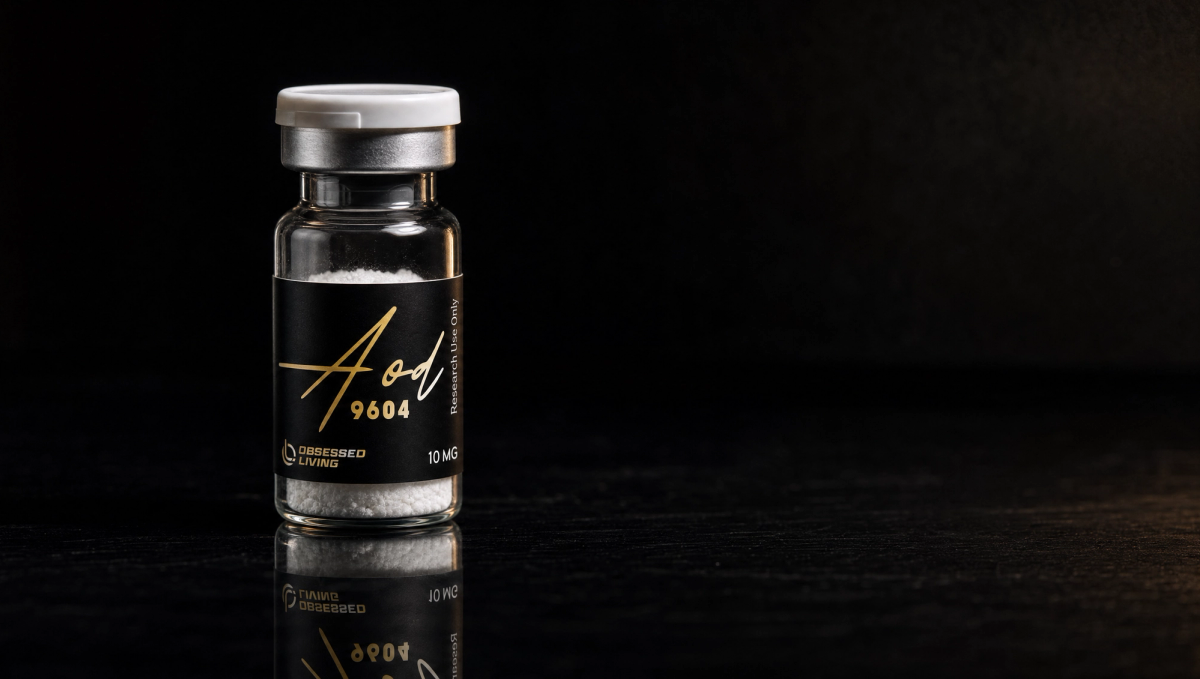
For an overview of the compound, see the [AOD-9604 research overview](/research/aod-9604). Related reading: [AOD-9604 vs full-length growth hormone](/blog/aod-9604-vs-full-length-hgh) and the [AOD-9604 Research FAQ](/blog/aod-9604-research-faq). Research-grade AOD-9604 is supplied as a lyophilized powder with a Certificate of Analysis, for laboratory research use only.
Research use only. Not for human consumption.
The Obsessed Living Research Team summarizes peer-reviewed peptide research for educational, research-use reference. Content is not medical advice.