Research Library · Obsessed Living Research Team
GHK-Cu: Research Overview, Mechanism & Published Studies
What GHK-Cu is
GHK-Cu is the copper(II) complex of the tripeptide glycyl-L-histidyl-L-lysine (GHK), a three-amino-acid sequence (glycine–histidine–lysine) that occurs naturally in human plasma, saliva, and urine [6]. GHK was first isolated in the 1970s and was noted to bind copper(II) with high affinity — comparable to the copper-transport site on serum albumin [4]. The resulting complex, GHK-Cu, is studied as the biologically active form of the molecule.
Structurally, the histidine residue provides the primary copper-coordination site, allowing GHK to chelate Cu²⁺ and form a stable tripeptide–metal complex. This copper-binding property is understood to be central to the biological activities researchers have investigated: studies note that Cu²⁺ ions are required for some of the observed effects — the tripeptide GHK alone does not reproduce all of them [3].
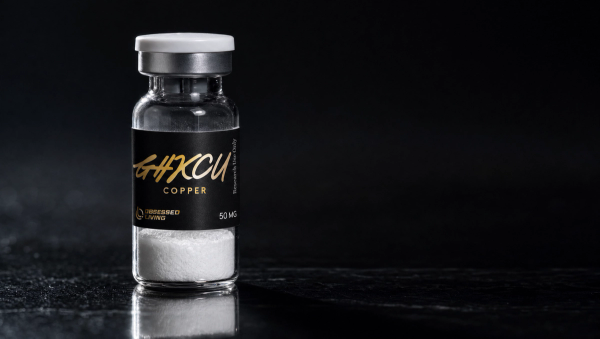
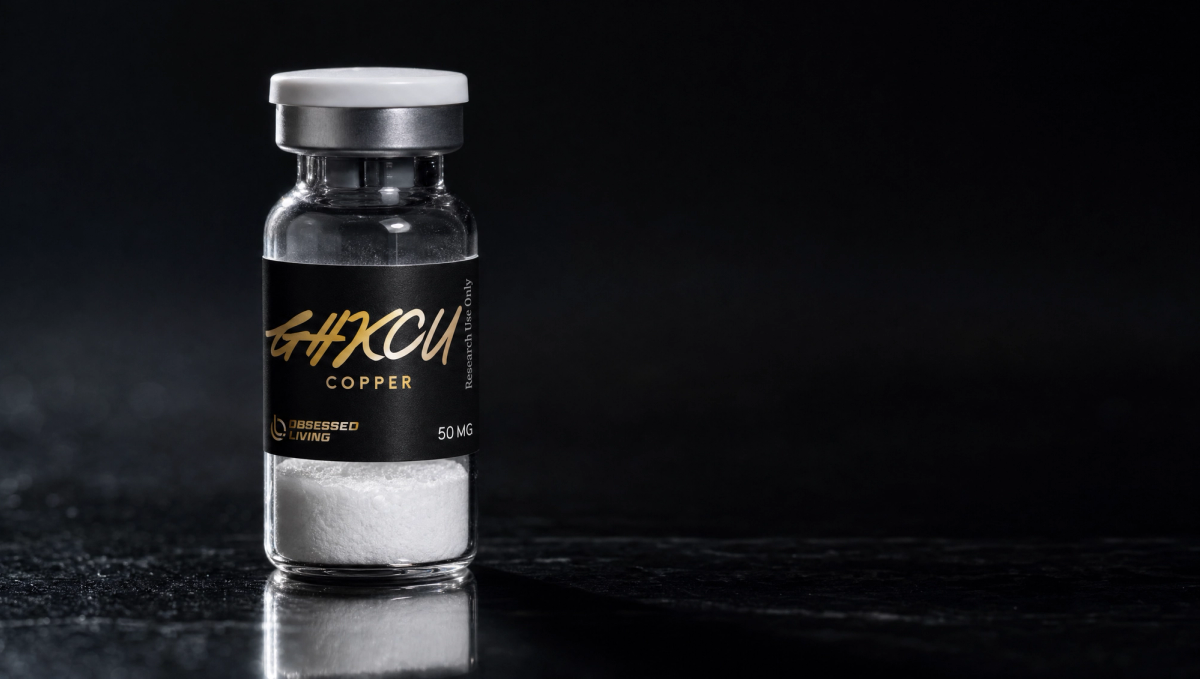
In a research setting, GHK-Cu is typically supplied as a lyophilized (freeze-dried) powder or dissolved peptide for in-vitro investigation. It is supplied for laboratory research use only and is not for human consumption.
Pathways published research has investigated
Published studies — spanning cell-culture models, animal wound models, and a smaller number of in-vivo human topical studies — have investigated GHK-Cu in the context of several biological pathways. These are descriptions of what researchers have *studied*, not statements of therapeutic effect in humans:
- Fibroblast activity and collagen synthesis. An early and frequently cited series of in-vitro studies examined GHK-Cu's relationship to collagen production in fibroblast cultures. Researchers reported concentration-dependent stimulation of collagen synthesis beginning at approximately 10⁻¹² M and peaking near 10⁻⁹ M, independent of changes in cell number [1]. Separately, in-vivo wound-chamber experiments reported a concentration-dependent increase in connective tissue accumulation in rat experimental wounds treated with GHK-Cu [2].
- Matrix metalloproteinase (MMP) and TIMP regulation. Cell-culture work investigated GHK-Cu's relationship to extracellular matrix remodeling at the enzymatic level. One study reported that GHK-Cu increased MMP-2 levels in conditioned media of cultured fibroblasts, an effect accompanied by a rise in MMP-2 mRNA and an increase in secretion of the tissue inhibitors of metalloproteinases TIMP-1 and TIMP-2 [3]. Investigators framed this as a dual regulation — both remodeling enzyme and its inhibitor — rather than simple activation of breakdown.
- Glycosaminoglycan synthesis. Research has also investigated GHK-Cu's relationship to glycosaminoglycan (GAG) production, with one study reporting stimulation of sulfated glycosaminoglycan synthesis in fibroblast models, suggesting involvement in broader extracellular matrix composition beyond collagen alone [1, 4].
- Gene-expression profiling. Broader review work analyzed GHK's relationship to gene expression relevant to skin biology, reporting that the peptide appeared to modulate a network of genes associated with tissue remodeling, TGF-β signaling, and antioxidant pathways — including observed regulation of MMP1, MMP2, and TIMP1 at nanomolar concentrations in cell-culture models [5, 6].
- Oxidative stress pathways. Pre-clinical work has investigated GHK-Cu in the context of oxidative stress. One animal study reported that GHK-Cu attenuated cigarette smoke-induced pulmonary inflammation, associated with decreased expression of inflammatory cytokines (IL-1β, TNF-α), a reduction in NF-κB activity, and an increase in the antioxidant regulator Nrf2 in lung tissue [7]. These observations are from a specific animal model and describe cellular signaling measurements, not general antioxidant effects in people.
- Collagen IV and dermal matrix co-studies. A more recent in-vitro and ex-vivo study examined GHK-Cu in combination with hyaluronic acid, reporting upregulation of collagen IV expression in fibroblast cultures and in excised skin samples [8]. The interaction between peptide and extracellular matrix components is an active area of laboratory investigation.
The state of the literature
It is important to characterize this body of work accurately. GHK-Cu has a longer research history than many research peptides — foundational in-vitro and in-vivo studies date to the late 1980s — but the literature varies considerably in quality and model type. The majority of mechanistic work has been conducted in cell-culture and animal models. Human data is more limited and, where it exists, is often from small topical dermatology studies focused on formulation delivery rather than mechanistic endpoints [9].
Comprehensive reviews of the GHK-Cu literature describe it as a peptide with a plausible and investigated mechanistic profile in extracellular matrix biology, but consistently note that robust large-scale clinical evidence is not yet available [6, 9]. The compound is not an approved drug.
This is precisely why credible discussion of GHK-Cu stays in the research register — "studies have investigated," "in-vitro models observed," "the pre-clinical literature reports" — rather than making claims about what the compound does for any person.
How researchers handle it
In laboratory settings, GHK-Cu is reconstituted from lyophilized powder and handled under standard aseptic conditions. Because copper chelation is central to its studied activity, researchers take care to use well-characterized material with defined copper coordination. A Certificate of Analysis confirming identity and purity (typically by HPLC and mass spectrometry) is standard practice for material used in published research.
Go deeper
- GHK-Cu: Mechanism in Published Studies — a closer look at the specific ECM, MMP/TIMP, and gene-expression pathways above.
- GHK-Cu vs Other Skin Peptides: What the Research Compares — how GHK-Cu differs from palmitoyl peptides and other dermatological research compounds in the literature.
- GHK-Cu Research FAQ — common questions about the compound, answered in a research context.
Research materials
Related compound: GHK-Cu — supplied as research-grade lyophilized powder with Certificate of Analysis. Research use only. Not for human consumption.
The Obsessed Living Research Team summarizes peer-reviewed peptide research for educational, research-use reference. Content is not medical advice. Our research standards.