Research Library · Obsessed Living Research Team
Glow Blend (GHK-Cu + BPC-157 + TB-500): Why These Peptides Are Paired in Research, and What the Literature Actually Shows
What the Glow blend is
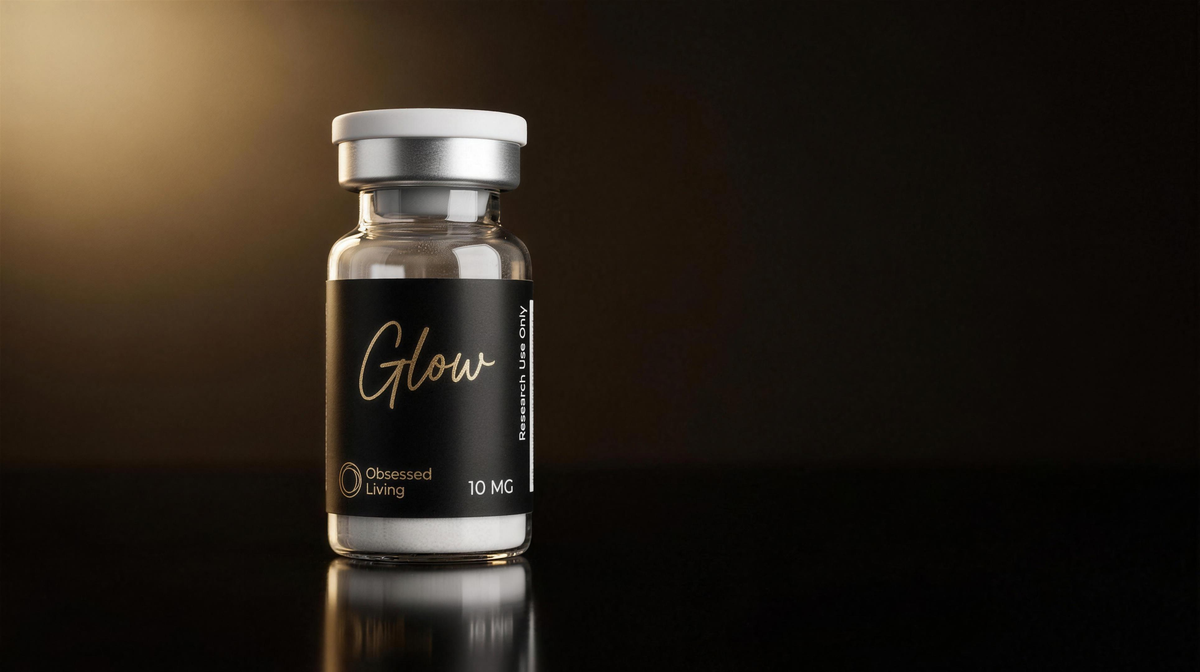
"Glow" is a commercial nickname for a combination research product pairing three peptides that each already carry their own standalone research literature: GHK-Cu, a naturally occurring copper-binding tripeptide (glycyl-L-histidyl-L-lysine) studied for its effects on fibroblast signaling and extracellular matrix turnover; BPC-157, a 15-amino-acid fragment associated with a gastric protective protein and studied in tissue-repair models; and TB-500, a commercial name for material related to thymosin beta-4 (Tβ4), the actin-binding protein studied in angiogenesis and wound-repair research. Vendors market the three together under names like "Glow" or the "Glow stack" on the premise that combining a matrix-remodeling peptide with two tissue-repair peptides covers more of the studied skin- and tissue-biology process than any one compound alone.
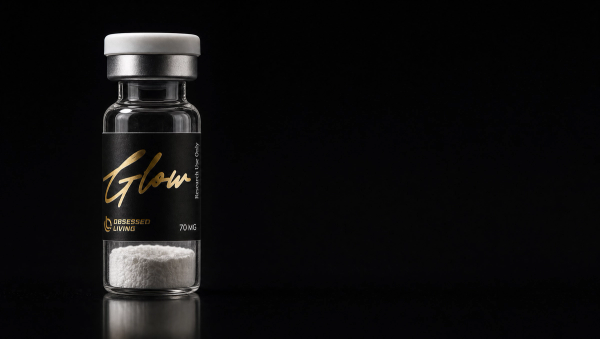
In a research setting, Glow-blend material is typically supplied as a lyophilized (freeze-dried) powder combining all three peptides for reconstitution and in-vitro or in-vivo investigation. It is supplied for laboratory research use only and is not for human consumption.
Why these three are paired in research framing
The pairing rationale rests on each peptide's own studied mechanism, not on a mechanism demonstrated for the three-way combination. GHK-Cu's studied pathways center on copper-dependent fibroblast signaling: early work reported that the tripeptide-copper complex stimulated collagen synthesis in fibroblast cultures and increased connective-tissue accumulation in rat experimental wounds in vivo [1, 2], later work found it also upregulates matrix metalloproteinase-2 expression in fibroblast cultures — part of the tissue-remodeling process rather than only tissue building [3] — and review literature describes GHK as influencing the expression of a large number of genes tied to antioxidant response, matrix remodeling, and tissue repair [4, 5, 6].
BPC-157's studied pathways include angiogenesis signaling correlated with VEGF expression in muscle and tendon healing models, and tendon-fibroblast outgrowth, survival, and migration in vitro [9, 10]. TB-500/Tβ4's studied pathways center on actin-binding biology: research isolating Tβ4's seven-amino-acid actin-binding motif found it reproduced Tβ4's angiogenic activity in endothelial-cell assays, and a rodent heart-injury model reported Tβ4 mobilized cardiac progenitor cells and promoted new vessel formation [11, 12].
The argument made for combining the three is that GHK-Cu's studied activity centers on matrix synthesis/remodeling and antioxidant gene signaling, while BPC-157 and TB-500 each separately study different entry points into angiogenesis and cell-migration biology. That is a mechanistic argument for why someone would design a three-peptide combination to test — it is not evidence that the combination outperforms any peptide alone, and no part of the individual literature behind any of the three peptides was generated by testing them together.
What a combined-administration study actually found
Most of what circulates about "Glow" online is vendor copy describing the three peptides separately and asserting synergy without a cited source. As of this writing, no peer-reviewed study has directly administered GHK-Cu, BPC-157, and TB-500 together and measured an outcome — the three-way combination has not been tested in the published literature.
The closest available data point is a 2026 study that tested two of the three components together: Bicer et al. randomized 32 rats into four groups — control, BPC-157 alone, TB-500 alone, and combined BPC-157 + TB-500 — following a standardized Achilles tendon transection and repair, with daily treatment for four weeks before biomechanical and histological evaluation [13]. TB-500 alone was the only group to show a statistically significant improvement in maximum load to failure versus control. The combined BPC-157 + TB-500 group reached significance on one histological measure versus control, but the study authors explicitly state that "combined BPC-157 and TB-500 treatment did not confer additional benefits compared to either agent alone." GHK-Cu was not part of that study at all. No equivalent combined-administration study exists for GHK-Cu paired with either peptide.
The state of the literature
This needs to be stated plainly: there is no published study — human or animal — that has tested the GHK-Cu + BPC-157 + TB-500 combination as sold under the "Glow" name. The only combined-administration data in this space comes from the two-peptide Bicer et al. 2026 rat study described above, and that study found no additive benefit from combining its two peptides over the better-performing single agent [13]. GHK-Cu's own literature is itself concentrated in in-vitro fibroblast/skin-equivalent models and older rodent wound studies, with recent reviews still describing its anti-wrinkle and matrix-remodeling evidence base as limited by small, often industry-funded topical trials [7, 8]. The individual literature behind BPC-157 and TB-500 is similarly concentrated in animal and in-vitro models, with recent reviews emphasizing that human clinical data for BPC-157 remains very limited and that no controlled human interventional studies of TB-500 exist in musculoskeletal research categories at all [10, 14].
None of the three compounds is FDA-approved for any use, and the Tβ4 fragment underlying TB-500 is listed by WADA as a prohibited substance for athletes [14]. Nothing in the current literature supports a claim that combining GHK-Cu, BPC-157, and TB-500 produces an effect beyond what any one of them produces alone; the only directly relevant combination study available found the opposite for the two peptides it did test together.
This is exactly why credible discussion of the Glow blend stays in the research register — "studies have investigated GHK-Cu's effect on collagen synthesis in fibroblast cultures," "a 2026 rat study found no additive effect from combining two of the three peptides" — rather than repeating the synergy claims common in vendor marketing copy that cites no study at all.
How researchers handle it
In laboratory use, Glow-blend material is reconstituted from lyophilized powder, commonly with bacteriostatic water, and handled under standard research conditions. Material supplied for research should carry a Certificate of Analysis confirming HPLC-verified purity for all three peptides in the blend so that what is being studied is well-characterized.
Research materials
Related product: Glow (GHK-Cu + BPC-157 + TB-500) — supplied as a research-grade lyophilized powder blend with Certificate of Analysis. Research use only. Not for human consumption.
The Obsessed Living Research Team summarizes peer-reviewed peptide research for educational, research-use reference. Content is not medical advice. Our research standards.