Research Library · Obsessed Living Research Team
Glutathione: Research Overview, Redox Biochemistry & Published Studies
What Glutathione is
Glutathione (GSH) is an endogenous tripeptide with the sequence γ-L-glutamyl-L-cysteinyl-glycine. It is the most abundant low-molecular-weight thiol compound synthesized within cells, found at intracellular concentrations typically in the millimolar range [1]. That structural designation — three amino acids joined by a characteristic gamma-peptide bond between glutamate and cysteine — is what distinguishes it from standard dipeptides and makes it resistant to cleavage by ordinary proteases.
GSH is synthesized in two sequential, ATP-dependent enzymatic steps. The first and rate-limiting step is catalyzed by glutamate-cysteine ligase (GCL, also historically called γ-glutamylcysteine synthetase), which joins L-glutamate and L-cysteine into γ-L-glutamyl-L-cysteine. The second step, catalyzed by glutathione synthetase, appends glycine to complete the tripeptide [2]. Because cysteine availability is typically the bottleneck in this pathway, the supply of cysteine — and compounds that affect it — is a significant variable in the biochemistry of GSH homeostasis.
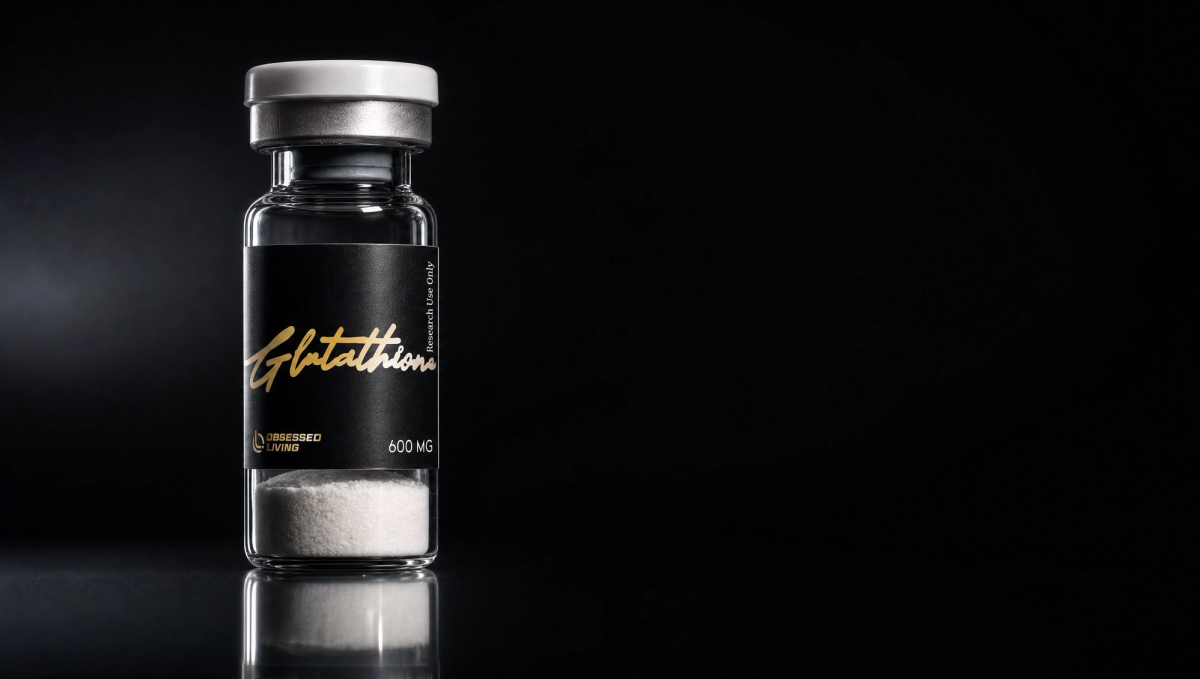
In a research setting, Glutathione is supplied as a lyophilized (freeze-dried) powder for in-vitro and laboratory investigation. It is supplied for laboratory research use only and is not for human consumption.
The GSH/GSSG redox couple — what the literature studies
The defining feature of glutathione in the research literature is its role as the cell's primary redox buffer, operating as the GSH/GSSG couple:
- Reduced form (GSH): Contains a free sulfhydryl (–SH) group on cysteine. This is the biologically active form in electron-transfer reactions.
- Oxidized form (GSSG): Two GSH molecules linked by a disulfide bond, formed when GSH donates electrons to neutralize reactive oxygen species (ROS).
Published biochemistry describes the intracellular GSH/GSSG ratio — typically 100:1 or higher under steady-state conditions — as a primary marker of cellular redox status. Under conditions of elevated oxidative challenge, this ratio decreases significantly, shifting toward GSSG [3]. Studies have used this ratio to characterize redox state across a wide range of cell-based experimental models.
The recycling of GSSG back to GSH is catalyzed by glutathione reductase (GR), an NADPH-dependent enzyme, linking the GSH system to the pentose-phosphate pathway and glucose-6-phosphate dehydrogenase [4].
Enzyme systems the literature associates with GSH
Published research has examined GSH as a cofactor or substrate in several distinct enzyme systems:
- Glutathione peroxidases (GPx). GPx enzymes use GSH to reduce hydrogen peroxide (H₂O₂) and lipid hydroperoxides, converting them to water (and the corresponding alcohol), while oxidizing GSH to GSSG. Research on GPx-1, in particular, has characterized this as a central node in intracellular H₂O₂ management in cell-culture models [4].
- Glutathione S-transferases (GSTs). This large superfamily of phase-II enzymes catalyzes the conjugation of GSH to electrophilic substrates — including xenobiotics and reactive metabolites — rendering products more water-soluble for cellular export. The literature characterizes GSTs as a major enzymatic family at the interface of GSH biochemistry and metabolic detoxification pathways [5].
- Glutaredoxins. Thiol-disulfide oxidoreductases that use GSH as a reductant to reduce protein disulfides and mixed disulfides, a system described in the redox-signaling literature as relevant to post-translational thiol modifications [6].
Compartmentalization
The biochemistry literature notes that GSH is not uniformly distributed: the cytoplasm holds the largest pool, while mitochondria maintain a separate GSH pool imported from the cytoplasm (mitochondria cannot synthesize GSH independently) [3]. Researchers have studied the mitochondrial pool separately because mitochondria are a primary site of ROS generation in cell-based metabolic models.
The state of the literature
Glutathione research is extensive, and the foundational enzymology — structure, biosynthetic pathway, GPx/GR/GST partnerships — is well-characterized from in-vitro and cell-culture work [1, 2, 3]. More recent literature has expanded into redox signaling, examining S-glutathionylation of proteins as a potential regulatory mechanism in cell models [6].
It is essential to characterize this body of work accurately: most mechanistic data on GSH systems comes from cell-culture and animal models. The compound is not an approved drug. Discussion of glutathione in a research context stays in the research register — "studies have examined," "in-vitro models observed," "the biochemistry literature reports" — rather than making claims about effects in people.
How researchers handle it
In laboratory use, Glutathione is typically handled as a lyophilized powder, reconstituted in aqueous buffer appropriate for the assay system. Material supplied for research should carry a Certificate of Analysis confirming HPLC-verified purity and identity so that the compound under study is well-characterized.
Go deeper
- Glutathione: Redox Balance & Oxidative Stress in Published Research — a focused look at the GSH/GSSG cycle, ROS chemistry, and the GPx/GR enzyme axis.
- Glutathione vs. Precursors: What the Research Compares — how the literature distinguishes direct GSH from biosynthetic precursors such as NAC and cysteine.
- Glutathione Research FAQ — common questions answered in a research context.
Research materials
Related compound: Glutathione — supplied as research-grade lyophilized powder with Certificate of Analysis. Research use only. Not for human consumption.
The Obsessed Living Research Team summarizes peer-reviewed peptide research for educational, research-use reference. Content is not medical advice. Our research standards.