Research Library · Obsessed Living Research Team
AOD-9604: Research Overview, Mechanism & Published Studies
What AOD-9604 is
AOD-9604 is a synthetic peptide derived from the C-terminal region of the human growth hormone (hGH) molecule — specifically the fragment spanning amino acids 176–191, the region of the hGH sequence researchers have associated with growth hormone's fat-metabolizing (lipolytic) activity, modified for stability [1, 6]. Because it corresponds to only a small piece of the full hGH molecule, published research has focused on whether it retains hGH's studied lipolytic activity without the growth-promoting and insulin-desensitizing effects associated with full-length hGH [1, 2, 6].
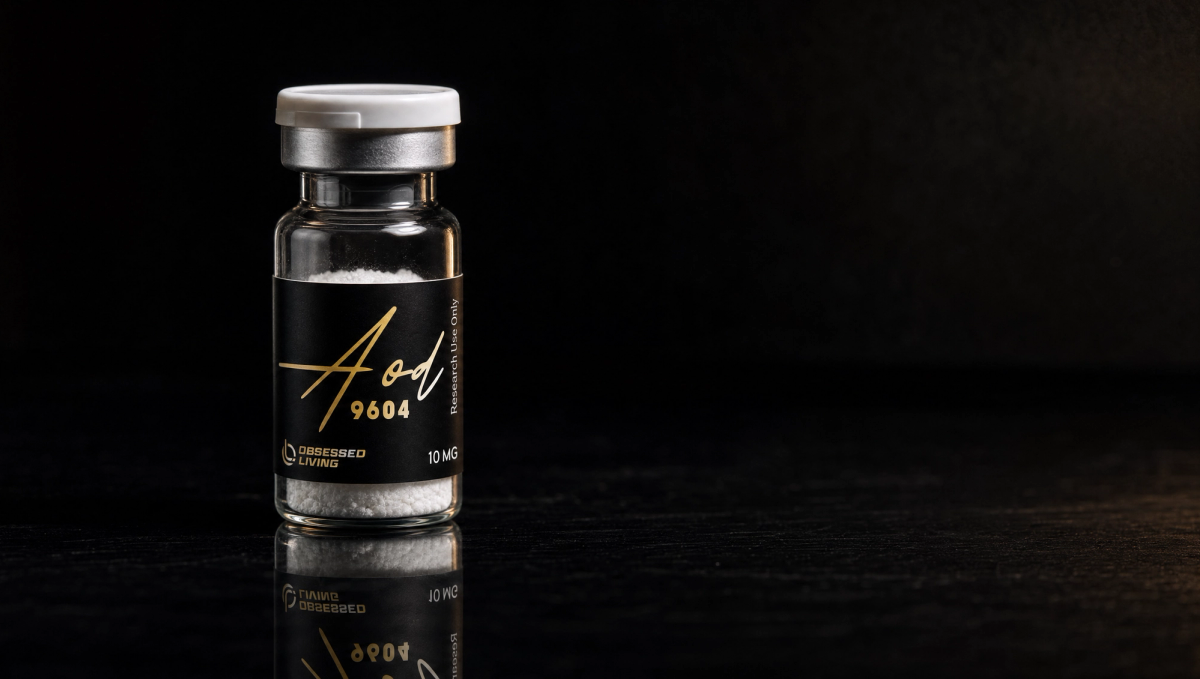
In a research setting, AOD-9604 is typically supplied as a lyophilized (freeze-dried) powder for reconstitution and in-vitro or in-vivo investigation. It is supplied for laboratory research use only and is not for human consumption.
Pathways published research has investigated
Published studies — spanning animal models, cell-based work, and a pooled analysis of early-phase human safety trials — have investigated AOD-9604 in the context of several biological pathways. These are descriptions of what researchers have studied, not statements of effect in humans:
Lipolysis in animal models. A foundational study in obese Zucker rats reported that oral AOD-9604 reduced body-weight gain relative to control over a 19-day dosing period, while — unlike full-length hGH in the same research — showing no measured effect on insulin sensitivity via euglycemic clamp technique [1].
Beta-3 adrenergic receptor (β3-AR) expression. Research comparing obese mice, lean mice, and β3-AR knockout mice found that both hGH and AOD-9604 elevated β3-AR RNA expression in obese animals toward levels seen in lean animals, and that acute AOD-9604 exposure still increased energy expenditure and fat oxidation even in knockout mice lacking the receptor — suggesting the studied lipolytic pathway is not solely β3-AR dependent [2].
Cartilage and joint-tissue models. An intra-articular injection study in a rabbit osteoarthritis model examined AOD-9604 with and without hyaluronic acid, evaluating effects on cartilage in that laboratory model [5].
Pharmacokinetics and metabolism. Non-clinical research reports a plasma half-life of roughly three minutes following intravenous administration in animal models, with oral bioavailability of approximately 40% in rats and principal tissue localization in pancreatic, thyroid, pineal, and renal tissue [4].
The state of the literature
AOD-9604 has more human safety data behind it than many other research peptides: a pooled analysis covering six early-phase trials and roughly 893 healthy, obese adult subjects reported a safety and tolerability profile "indistinguishable from placebo," with no serious adverse events and no clinically significant changes in IGF-1, glucose tolerance, or insulin resistance [3]. Non-clinical toxicology — including genotoxicity assays and chronic oral-dosing studies in rats and cynomolgus monkeys — reported no treatment-related toxicity at the doses tested [4].
It is important to characterize the rest of the picture accurately, though. A later-stage (phase IIB) clinical trial evaluating AOD-9604 as an obesity treatment did not produce results supporting commercial development for that indication, according to an independent peer-reviewed review of obesity pharmacotherapies [6]. AOD-9604 has not been approved by the FDA or any regulator as a drug for any use, and it is not a nutritional supplement. The research framing reflects that: studies describe mechanisms and safety signals observed in controlled research settings, not an established, approved outcome in people.
This is exactly why credible discussion of AOD-9604 stays in the research register — "studies have investigated," "animal models reported," "the pooled safety analysis found" — rather than making claims about what the compound does for a person.
How researchers handle it
In laboratory use, AOD-9604 is reconstituted from lyophilized powder, commonly with bacteriostatic water, and handled under standard research conditions. Material supplied for research should carry a Certificate of Analysis confirming HPLC-verified purity so that what is being studied is well-characterized.
Go deeper
AOD-9604: mechanism of action in published studies — a closer look at the lipolysis and β3-AR pathways above.
AOD-9604 vs full-length growth hormone: what the research compares — how the fragment's studied profile differs from hGH in the literature.
AOD-9604 research FAQ — common questions, answered in a research context.
Research materials
Related compound: AOD-9604 — supplied as research-grade lyophilized powder with Certificate of Analysis. Research use only. Not for human consumption.
The Obsessed Living Research Team summarizes peer-reviewed peptide research for educational, research-use reference. Content is not medical advice. Our research standards.