Research Library · Obsessed Living Research Team
Ipamorelin: Research Overview, Mechanism & Published Studies
What Ipamorelin is
Ipamorelin is a synthetic pentapeptide — five amino acids — belonging to the class of compounds known as growth hormone secretagogues (GHS). It was characterized in the peer-reviewed literature in the late 1990s and was notably described as "the first selective growth hormone secretagogue" in research distinguishing it from earlier peptides in the same class [1]. Its chemical structure was derived from a series of GHRP (growth hormone-releasing peptide) analogs that were designed to interact with the ghrelin receptor [2].
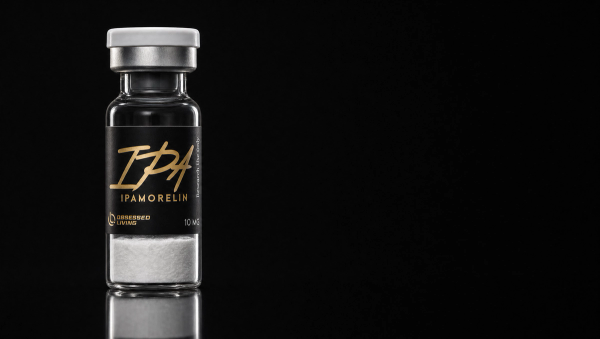
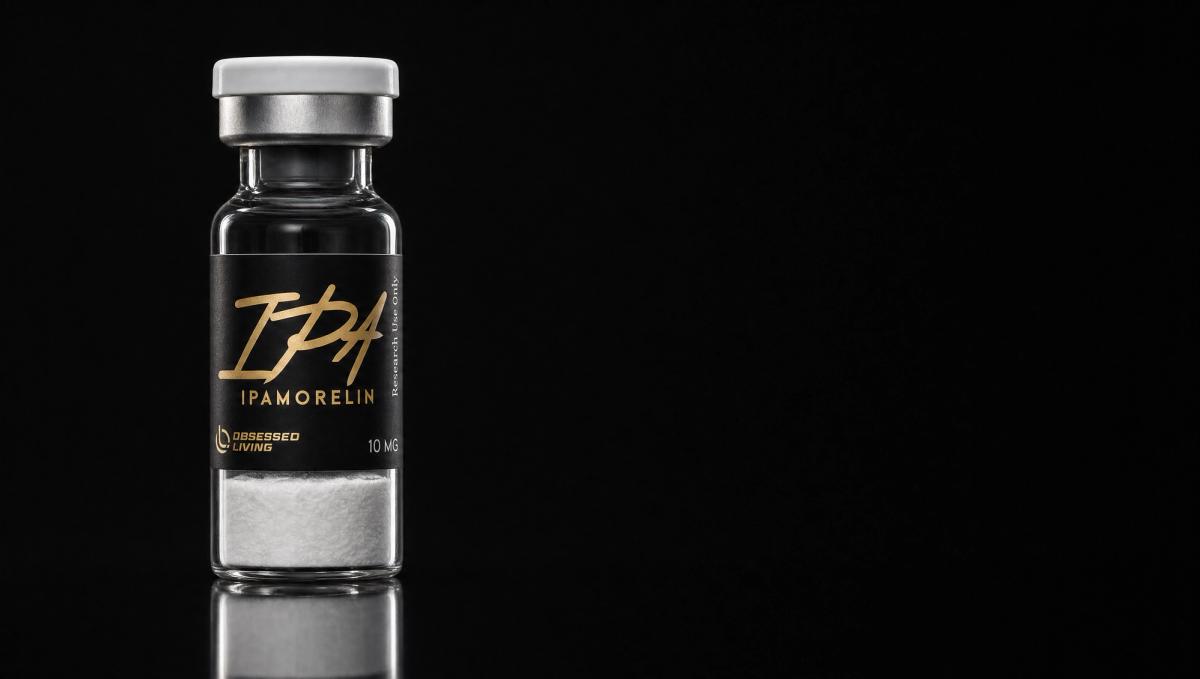
In a research setting, Ipamorelin is typically supplied as a lyophilized (freeze-dried) powder for reconstitution and in-vitro investigation. It is supplied for laboratory research use only and is not for human consumption.
Pathways published research has investigated
Published studies — predominantly in animal and in-vitro (cell-based) models — have investigated Ipamorelin in the context of several biological pathways. These are descriptions of what researchers have *studied*, not statements of effect in humans:
- GHSR-1a (ghrelin receptor) binding. Ipamorelin is studied as an agonist at the ghrelin/growth hormone secretagogue receptor type 1a (GHSR-1a), the G-protein-coupled receptor through which ghrelin exerts its known signaling effects [3]. Research has characterized this interaction in terms of receptor affinity, selectivity, and downstream intracellular signaling in pituitary cell assays [1].
- Pituitary GH release. Studies in animal and pituitary cell models have investigated Ipamorelin's capacity to stimulate growth hormone release from somatotroph cells. Research has examined the relationship between GHSR-1a activation and GH pulse amplitude in these models [1, 4].
- Selectivity profile vs. other pituitary hormones. A defining area of research on Ipamorelin has been its selectivity — specifically, studies have examined whether it triggers release of other pituitary hormones such as cortisol (via ACTH) or prolactin alongside GH. Published literature has characterized Ipamorelin as more selective in this respect compared to earlier GH-releasing peptides [1, 5].
- Gastrointestinal motility signaling. Because the ghrelin receptor is expressed throughout the gastrointestinal tract, research has investigated Ipamorelin as a "ghrelin mimetic" in models of gastrointestinal motility. In-vitro and rodent studies have examined its effects on gastric transit and GI function [6, 7].
- GH/IGF-1 axis activity. Review literature on GH secretagogues as a class has examined how compounds like Ipamorelin interact with the broader GH/IGF-1 axis in laboratory models, with noted associations to lean body mass and bone turnover parameters observed in preclinical settings [5].
The state of the literature
It is important to characterize this body of work accurately. The majority of Ipamorelin research has been conducted in animal and cell-culture models, and reviews of the GH secretagogue literature are explicit that few long-term, rigorously controlled human studies exist [5]. A review of GHS compounds in the context of body composition noted that the evidence base, while mechanistically interesting, remains limited in clinical scope [8].
This is exactly why credible discussion of Ipamorelin stays in the research register — "studies have investigated," "animal models observed," "the pre-clinical literature reports" — rather than making claims about what the compound does for a person.
How researchers handle it
In laboratory use, Ipamorelin is reconstituted from lyophilized powder, commonly with bacteriostatic water, and handled under standard research conditions. Material supplied for research should carry a Certificate of Analysis confirming HPLC-verified purity so that what is being studied is well-characterized. Anti-doping research has also investigated the metabolite profile of Ipamorelin following administration in controlled settings, noting that it undergoes intensive metabolism compared to some other GHRPs in the same class [9].
Go deeper
- Ipamorelin and the Ghrelin/GHSR-1a Receptor in Published Research — a closer look at what the receptor-binding literature describes.
- Ipamorelin vs. Other GH-Releasing Peptides: What the Research Compares — how Ipamorelin differs from GHRP-2, GHRP-6, and Hexarelin in the pre-clinical record.
- Ipamorelin Research FAQ — common questions, answered in a research context.
Research materials
Related compound: Ipamorelin — supplied as research-grade lyophilized powder with Certificate of Analysis. Research use only. Not for human consumption.
The Obsessed Living Research Team summarizes peer-reviewed peptide research for educational, research-use reference. Content is not medical advice. Our research standards.