Research Library · Obsessed Living Research Team
NAD+: Research Overview, Mechanism & Published Studies
What NAD+ is
NAD+ (nicotinamide adenine dinucleotide) is a dinucleotide coenzyme present in every living cell. It functions as an electron carrier in redox reactions — accepting electrons to become NADH — and as a signaling substrate consumed by several classes of enzymes, including sirtuins (NAD+-dependent deacetylases) and poly(ADP-ribose) polymerases (PARPs) [1, 2]. Its oxidized form (NAD+) and reduced form (NADH) together constitute one of the most fundamental redox couples in biochemistry.
In cellular biology, NAD+ participates in glycolysis, the citric-acid cycle, and the mitochondrial electron-transport chain. It is synthesized endogenously via two main routes: the de-novo pathway from tryptophan, and the salvage pathway from nicotinamide precursors — a route in which the rate-limiting enzyme is nicotinamide phosphoribosyltransferase (NAMPT) [3].
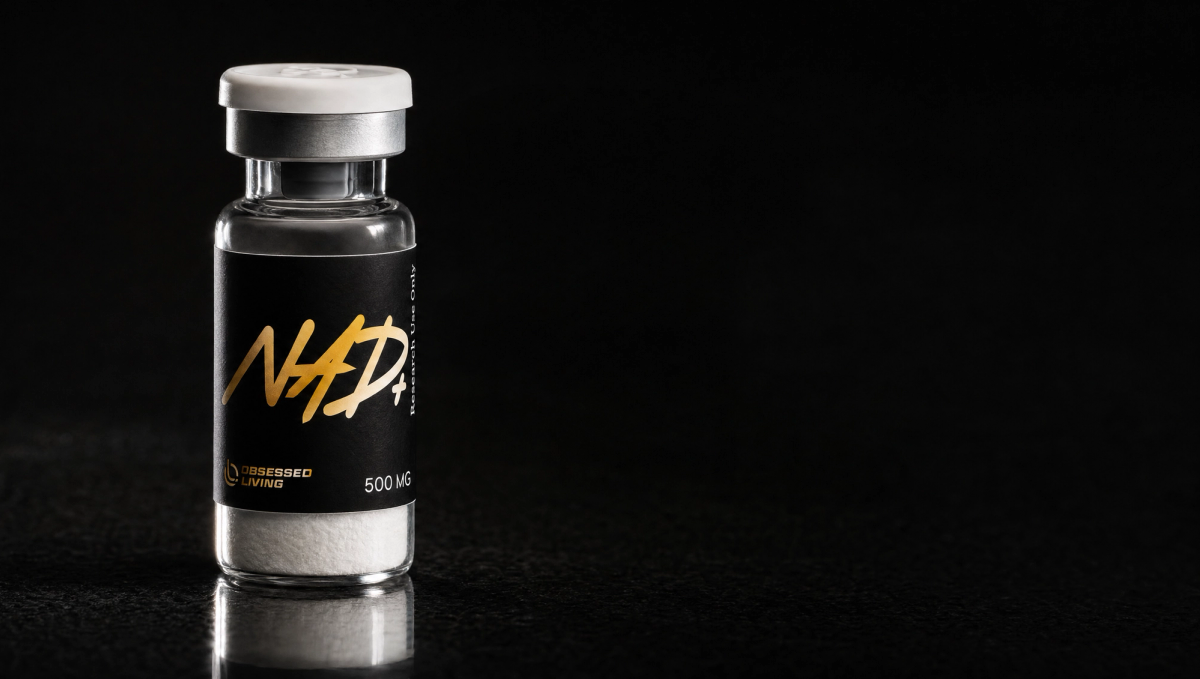
In a research setting, NAD+ is supplied as a reagent-grade compound for in-vitro and biochemical investigation. It is supplied for laboratory research use only and is not for human consumption.
Pathways published research has investigated
Published studies have examined NAD+ in the context of several intersecting biological pathways. The descriptions below reflect what researchers have *studied* in laboratory, animal, and early clinical models — not statements of established therapeutic effect in humans:
- Sirtuin signaling. NAD+ is the obligate co-substrate for sirtuin enzymes (SIRT1–SIRT7), which deacetylate histones and key regulatory proteins in an NAD+-dependent manner. Research in model organisms observed that modulating NAD+ levels influenced SIRT1/SIRT2 activity and associated longevity-related signaling, including activation of the mitochondrial unfolded protein response (UPRmt) and FOXO transcription factor DAF-16 [4]. A closely related line of work explored SIRT3, the predominant mitochondrial sirtuin, and its role in regulating mitochondrial protein acetylation and reactive-oxygen-species levels [5].
- Mitochondrial function. Because NAD+ feeds directly into the electron-transport chain via complex I, research has investigated how changes in cellular NAD+ pools relate to mitochondrial bioenergetics. Studies in animal models examined whether pharmacological restoration of NAD+ could influence mitochondrial function under conditions of metabolic stress [6]. Reviews characterize this relationship as bidirectional: impaired mitochondrial function can accelerate NAD+ consumption, while NAD+ availability appears to influence mitochondrial dynamics in laboratory models [7].
- NAMPT salvage pathway and PARP. The salvage pathway, governed by NAMPT, recycles nicotinamide to regenerate NAD+. Research has investigated how this pathway interacts with PARP1, which consumes NAD+ as an ADP-ribose donor during the DNA-damage response; studies have examined the balance between PARP-mediated NAD+ consumption and NAMPT-dependent resynthesis under oxidative-stress conditions [3, 8].
- Cellular senescence and age-associated NAD+ decline. A body of work has examined the observation that measured NAD+ levels are lower in aged tissues across multiple species. Research has investigated the CD38 axis as a mechanistic contributor: senescent-cell secretory factors (SASP) appear to recruit CD38-expressing macrophages, and CD38 is itself an NAD+ hydrolase — providing a proposed mechanistic link between the accumulation of senescent cells, inflammatory signaling, and tissue NAD+ availability in aged organisms [9, 10]. Narrative reviews note that this relationship is complex and the direction of causality remains an active area of investigation [11].
The state of the literature
The NAD+ field is active and spans a wide range from basic biochemistry to early-phase human trials. The coenzyme's role in core metabolism is well-established; its roles in sirtuin signaling and cellular senescence are supported by substantial pre-clinical evidence. However, it is important to frame the translational status accurately:
- Most mechanistic work has been conducted in cell culture and rodent models.
- Human clinical data on NAD+ precursor compounds (NMN and NR) is accumulating but remains early-stage: trials are generally small, short in duration, and focused on safety and pharmacokinetics rather than clinical outcomes [12, 13].
- Recent reviews note that "universal truth or confounded consensus" is still a fair characterization of the age-related NAD+ decline narrative in humans, given variability across tissue types and measurement methods [11].
This is precisely why credible discussion of NAD+ remains in the research register — "studies have investigated," "in-vitro models observed," "the pre-clinical literature reports" — rather than claiming what NAD+ does for any person.
How researchers handle it
In biochemical research, NAD+ is used as a substrate or co-factor in enzyme-activity assays, redox measurements, and cell-based models. Precursor compounds NMN and NR are studied for their ability to raise intracellular NAD+ pools in cell and animal models; NR in particular has been characterized as orally bioavailable in both mice and humans in published pharmacokinetic studies [14]. Research-grade material should carry a Certificate of Analysis confirming purity.
Go deeper
- NAD+, Sirtuins & Mitochondrial Function in Published Research — a closer look at the SIRT1/SIRT3 axis and what laboratory studies have observed about mitochondrial dynamics.
- NAD+ vs NMN vs NR: What the Precursor Research Compares — how the three forms are differentiated in the pharmacokinetic and pre-clinical literature.
- NAD+ Research FAQ — common questions, answered in a research context.
Research materials
Related compound: NAD+ — supplied as research-grade material with Certificate of Analysis. Research use only. Not for human consumption.
The Obsessed Living Research Team summarizes peer-reviewed peptide research for educational, research-use reference. Content is not medical advice. Our research standards.