Research Library · Obsessed Living Research Team
TB-500 (Thymosin Beta-4): Research Overview, Mechanism & Published Studies
What TB-500 is
"TB-500" is a commercial name used for synthetic peptide products described as related to thymosin beta-4 (Tβ4) — specifically to the seven-amino-acid actin-binding region of that 43-amino-acid protein (the LKKTETQ motif) [1, 4]. Tβ4 itself is the major actin-sequestering protein in most eukaryotic cells, meaning it binds free actin monomers and regulates how cells build and rebuild their internal cytoskeleton — the basis for the cell-migration and tissue-remodeling activity researchers have studied [1, 4].
This is also where the single most important caveat in the TB-500 literature shows up. A 2026 scoping review of 80 studies on Tβ4/TB-500 in tissue healing and musculoskeletal repair found that roughly 87.5% of the evidence base evaluated full-length Tβ4 directly — and that direct evidence specifically labeled "TB-500" was limited to a single included study, which was a metabolite-profiling and fibroblast-screening study, not a musculoskeletal repair model [5]. The review's authors state plainly that Tβ4 and TB-500 "are not interchangeable when the question is whether a specific peptide or peptide-labeled product has clinically useful effects" [5]. This article uses "TB-500" and "Tβ4" as the literature itself uses them — distinctly — rather than treating commercial branding as a stand-in for a well-defined research subject.
In a research setting, Tβ4/TB-500 material is typically supplied as a lyophilized (freeze-dried) powder for reconstitution and in-vitro or in-vivo investigation. It is supplied for laboratory research use only and is not for human consumption.
Pathways published research has investigated
Published studies — overwhelmingly in animal models and cell culture, using full-length Tβ4 — have investigated the following pathways. These are descriptions of what researchers have studied, not statements of effect in humans:
Actin-binding and angiogenesis. Research isolating the seven-amino-acid actin-binding motif within Tβ4 found that this fragment alone showed angiogenic activity comparable to full-length Tβ4 in endothelial-cell migration and vessel-sprouting assays, while versions of the peptide lacking the motif were inactive — identifying the actin-binding region as the functional site researchers associate with the angiogenic signal [1].
Cardiac progenitor mobilization. An animal-model study reported that Tβ4 activated and mobilized adult epicardial progenitor cells and promoted new blood-vessel formation (neovascularization) in the heart following induced injury, a finding researchers have pointed to as a basis for further cardiac-repair research [2].
Connective-tissue organization in wound healing. A rat incisional-wound study reported that local Tβ4 treatment produced narrower wounds with better-organized collagen and fewer myofibroblasts (the scar-associated cell type) compared to untreated wounds, with treated tissue showing microscopic features consistent with more mature connective tissue [3].
Broader angiogenesis signaling. A review of the angiogenesis literature describes Tβ4's studied role across wound repair, tumor vascularization research, and cardiovascular research models, characterizing it as a peptide of interest for ischemic-tissue research specifically because of these studied vascular pathways [4].
The state of the literature
This is a case where the honest answer matters more than the list of studied pathways above. The 2026 scoping review found that human studies of Tβ4/TB-500 are concentrated almost entirely in ocular/cornea and wound/skin/soft-tissue research settings — and that there are no human interventional studies of administered Tβ4 or TB-500 in tendon, ligament, muscle, bone, cartilage, adipose, or spine research categories, the areas where TB-500 is most often discussed in non-research settings [5]. Direct musculoskeletal research on TB4/TB-500 (tendon, ligament, muscle, cartilage, spine) was described as "comparatively sparse" relative to the wound-healing and vascular literature [5].
The regulatory picture reinforces the research gap rather than closing it. The FDA has listed the Tβ4 fragment (LKKTETQ) among bulk drug substances that may present significant safety risks in compounding, citing limited human exposure and safety data, and the World Anti-Doping Agency classifies Tβ4 and its derivatives — including TB-500 — as prohibited substances [5]. TB-500 and Tβ4 are not FDA-approved for any use, and TB-500 is not a nutritional supplement.
This is exactly why credible discussion of TB-500 stays in the research register — "animal models reported," "the scoping review found," "researchers have studied" — rather than making claims about what the compound does for a person, and why it specifically distinguishes what has been studied about Tβ4 from what has actually been tested under the TB-500 label.
How researchers handle it
In laboratory use, Tβ4/TB-500 material is reconstituted from lyophilized powder, commonly with bacteriostatic water, and handled under standard research conditions. Material supplied for research should carry a Certificate of Analysis confirming HPLC-verified purity so that what is being studied is well-characterized — a point the scoping review raises directly, noting that products marketed outside regulated pathways may vary in labeling, composition, and purity [5].
Go deeper
TB-500: mechanism of action in published studies — a closer look at the actin-binding, angiogenesis, and cardiac-progenitor pathways above.
TB-500 vs BPC-157: what the research compares — how these two frequently-paired research peptides differ in origin and studied mechanism.
TB-500 research FAQ — common questions, answered in a research context.
Research materials
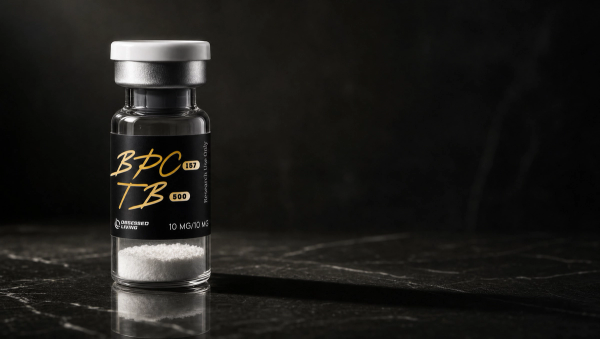
Related product: BPC-157 / TB-500 — currently sold as a combined research-grade kit, supplied as research-grade lyophilized powder with Certificate of Analysis. Research use only. Not for human consumption.
The Obsessed Living Research Team summarizes peer-reviewed peptide research for educational, research-use reference. Content is not medical advice. Our research standards.