Research Library · Obsessed Living Research Team
CJC-1295: Research Overview, Mechanism & Published Studies
What CJC-1295 is
CJC-1295 is a synthetic peptide composed of 30 amino acids. It is a tetra-substituted analog of the first 29 amino acids of human growth-hormone-releasing hormone (hGRF[1-29]), with a reactive maleimidopropionic acid (MPA) group at its C-terminus that enables covalent binding to plasma proteins — primarily albumin — after administration [1, 2]. This structural feature is what researchers have studied as the basis for its markedly extended plasma half-life compared with native GHRH, which is rapidly cleaved by circulating proteases in unmodified form.
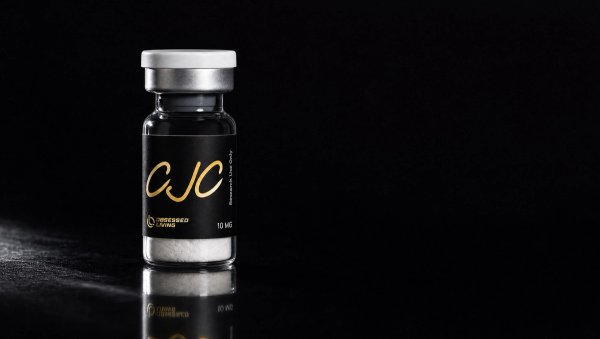
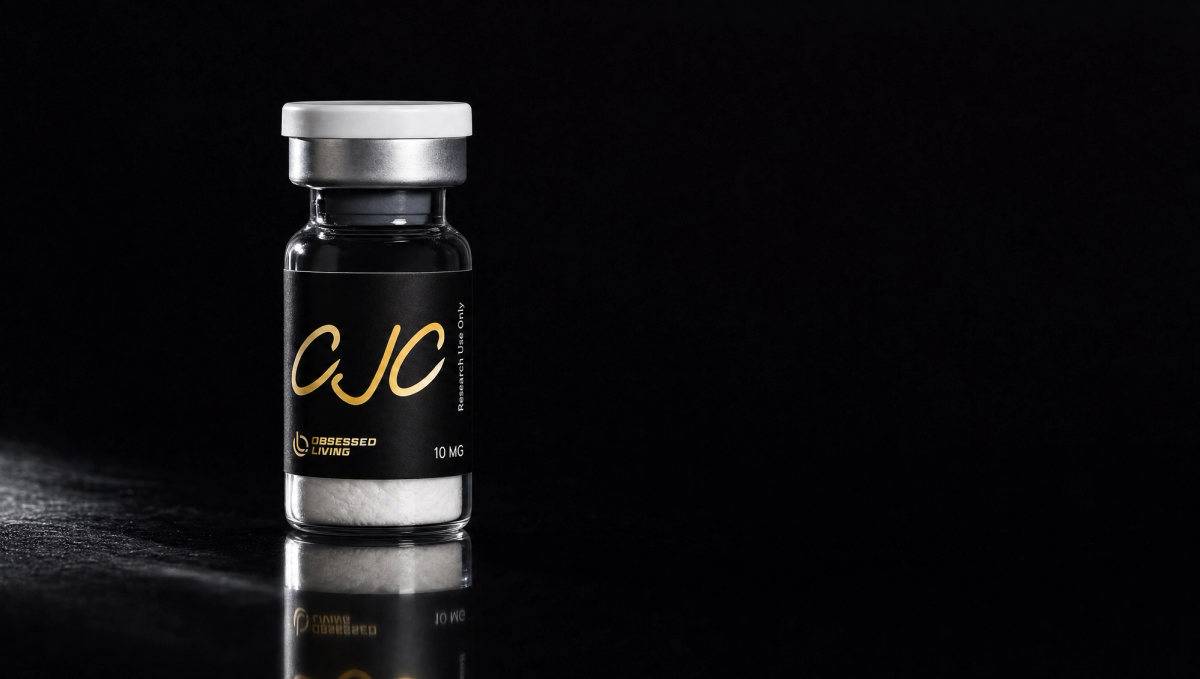
In a research setting, CJC-1295 is typically supplied as a lyophilized (freeze-dried) powder for reconstitution and in-vitro or pre-clinical investigation. It is supplied for laboratory research use only and is not for human consumption.
Structural context: where CJC-1295 sits in the GHRH-analog family
CJC-1295 belongs to a family of synthetic peptides that act as agonists at the GHRH receptor (GHRH-R), a Class II G-protein-coupled receptor expressed on pituitary somatotrope cells [3]. Other members of this research family include Sermorelin (hGRF[1-29]NH₂, 29 residues) and Tesamorelin (a trans-3-hexenoic acid–conjugated full 44-residue GHRH sequence). Each represents a distinct structural engineering approach to the same receptor target; published research comparing the three analogs is reviewed in the [CJC-1295 vs. Sermorelin vs. Tesamorelin spoke](/blog/cjc-1295-vs-sermorelin-tesamorelin).
Pathways published research has investigated
Published studies — spanning animal models, in-vitro systems, and early-phase human pharmacokinetic trials — have investigated CJC-1295 in the context of several biological pathways. These are descriptions of what researchers have *studied*, not statements of effect or benefit in humans:
- GHRH-receptor binding and cAMP signaling. The GHRH receptor belongs to the G-protein-coupled receptor superfamily. When GHRH (or an analog) binds, the receptor couples to Gs proteins, activating adenylyl cyclase to produce cAMP, which in turn activates protein kinase A (PKA) and promotes GH gene expression and secretion [3, 4]. CJC-1295's modifications are studied in the context of whether they preserve this receptor-binding capacity while extending the plasma half-life.
- Albumin-binding and plasma half-life extension. The MPA group on CJC-1295 is designed to react with free thiol groups on albumin after subcutaneous administration. Researchers have described this as a "Drug Affinity Complex" (DAC) mechanism; preclinical work confirmed that hGRF(1-29)-albumin conjugates retained GHRH-receptor activation capacity in anterior pituitary models [2].
- GH and IGF-1 axis stimulation in pharmacokinetic studies. A Phase 1/2 dose-escalation study in healthy adult volunteers reported dose-dependent increases in mean plasma GH concentrations lasting 6 days or more after a single administration, and mean IGF-1 concentrations elevated for 9–11 days, with evidence of cumulative effect across multiple doses [1].
- Pulsatile GH secretion preservation. A separate published study examined whether CJC-1295 preserved the physiological pulsatile pattern of GH secretion, reporting that once-daily administration in an animal model maintained pulsatility while augmenting GH output [5]. Separately, a once-weekly administration protocol was explored in pre-clinical models [5].
- Serum protein profile changes downstream of GH/IGF-1 axis activation. Researchers used proteomic methods to characterize changes in serum protein profiles in subjects who received CJC-1295, identifying downstream markers of GH/IGF-1 axis activation as a potential biomarker approach [6].
The state of the literature
It is important to characterize this body of work accurately. CJC-1295's published literature is relatively focused compared with some other research peptides: the strongest data come from a small number of early-phase clinical pharmacokinetic studies in healthy adults, plus preclinical animal-model work examining receptor activation and half-life extension [1, 2, 5]. A broader review of peptide-based pharmacological approaches to neuroendocrine signaling places CJC-1295 in the context of Class II GPCR ligand modification strategies [7].
There are no large-scale, peer-reviewed randomized controlled trials of CJC-1295 in disease populations. The compound is not an approved drug. The research framing reflects that: studies describe pharmacokinetic observations and molecular mechanisms in controlled research settings, not validated clinical outcomes.
How researchers handle it
In laboratory use, CJC-1295 is reconstituted from lyophilized powder under standard research conditions. Detection and analytical methods — including LC-MS/MS and immunoPCR-based assays — have been developed and peer-reviewed to characterize CJC-1295 and related analogs in biological matrices, reflecting growing interest in analytical characterization of GHRH-based research compounds [8, 9].
Go deeper
- CJC-1295, the GHRH Receptor & Half-Life in Published Research — a closer look at the molecular modifications and signaling pathway studies.
- CJC-1295 vs. Sermorelin vs. Tesamorelin: What the Research Compares — structural and pharmacological differences across three GHRH-based research analogs.
- CJC-1295 Research FAQ — common questions about CJC-1295, answered in a research context.
Research materials
Related compound: CJC-1295 — supplied as research-grade lyophilized powder with Certificate of Analysis. Research use only. Not for human consumption.
The Obsessed Living Research Team summarizes peer-reviewed peptide research for educational, research-use reference. Content is not medical advice. Our research standards.