Research Library ·
LL-37: Research Overview, Mechanism & Published Studies
What LL-37 is
LL-37 is the only cathelicidin-family antimicrobial peptide encoded in the human genome. It is a 37-residue, cationic, amphipathic peptide generated by extracellular cleavage of its precursor protein, hCAP-18, which is stored in neutrophil granules and produced by epithelial cells at barrier surfaces such as skin, lung, and gut. Research has identified proteinase 3, a serine protease also released from neutrophil azurophil granules, as the enzyme responsible for cleaving hCAP-18 into active LL-37 after exocytosis, a processing step distinct from how related cathelicidins are activated in other species.
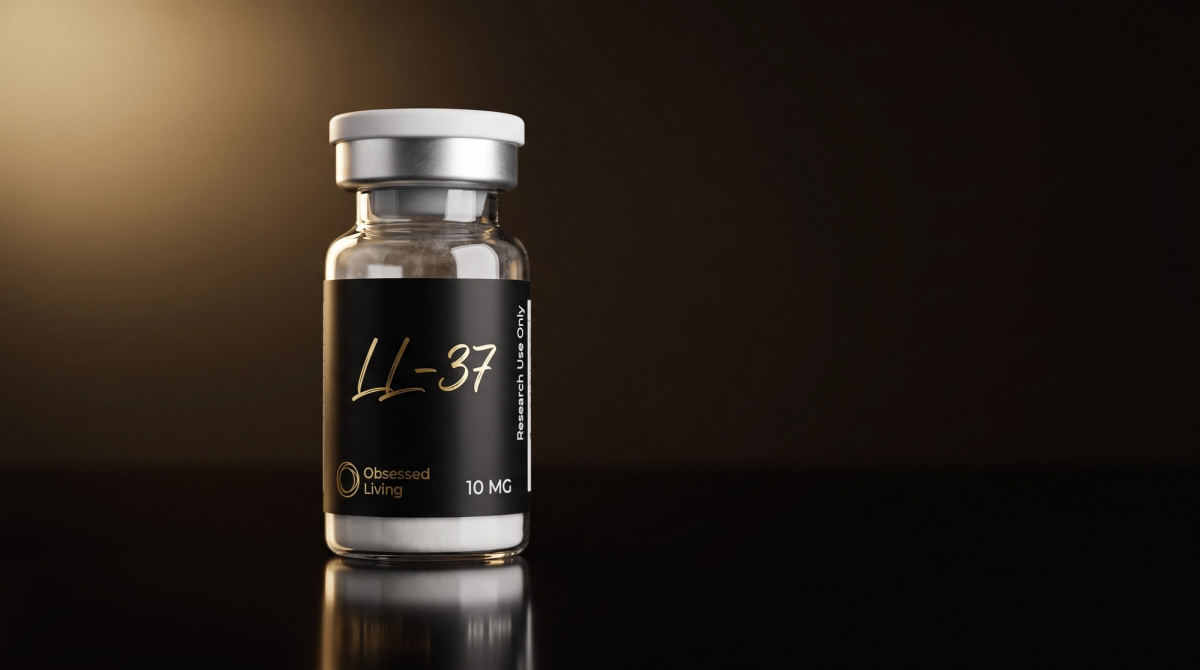
In a research setting, LL-37 is typically supplied as a lyophilized (freeze-dried) powder for reconstitution and in-vitro or in-vivo investigation. It is supplied for laboratory research use only and is not for human consumption.
Pathways published research has investigated
Published studies — spanning structural biology, cell-based work, animal models, and a body of human tissue and clinical-trial research larger than most peptides in this category — have investigated LL-37 across several biological pathways. These are descriptions of what researchers have studied, not statements of effect in humans.
Direct antimicrobial activity: structural research has shown LL-37 is disordered in pure water but adopts an alpha-helical conformation in the presence of specific anions, membrane-mimicking environments, or at higher peptide concentrations, and that this helical conformation correlates directly with antibacterial potency against both Gram-positive and Gram-negative bacteria in laboratory assays.
Angiogenesis signaling: a study using chorioallantoic membrane assays and a rabbit hind-limb ischemia model reported that LL-37 stimulated new blood vessel formation via the formyl peptide receptor-like 1 (FPRL1) on endothelial cells, and that mice deficient in the related peptide CRAMP showed impaired wound vascularization.
Skin re-epithelialization: research using organ-cultured human skin reported that LL-37/hCAP-18 levels rise during normal acute-wound healing and that antibody-mediated neutralization of LL-37 inhibited re-epithelialization in a concentration-dependent manner. Chronic ulcer tissue contained only 10-30% of the LL-37 protein levels seen in acute wounds, despite comparable mRNA.
Innate-immune activation via self-DNA: research published in Nature reported that LL-37 binds self-DNA released from damaged or dying cells, forming aggregated complexes that activate Toll-like receptor 9 (TLR9) in plasmacytoid dendritic cells, converting otherwise inert self-DNA into a trigger for interferon production. The authors linked this mechanism to the aberrant immune activation observed in psoriasis.
Vitamin D-dependent gene regulation: research has identified the human cathelicidin (CAMP) gene as a direct transcriptional target of the vitamin D receptor, with 1,25-dihydroxyvitamin D3 exposure strongly up-regulating cathelicidin expression in myeloid cells in laboratory models.
Cancer biology: a review of the cancer literature describes a paradoxical, tissue-dependent role — published research reports LL-37 promoting progression in some cancer types (including lung, ovarian, and breast cancer models, via mechanisms such as EGFR/MAPK signaling) while suppressing growth in others (including colon and gastric cancer models, via pro-apoptotic signaling), with the divergence attributed to differing receptor expression across cancer cell types.
The state of the literature
LL-37 has one of the deeper human-tissue research bases among peptides in this category, because it is an endogenously produced human protein rather than a purely synthetic research compound — it has been studied directly in human skin, saliva, and plasma samples, not only in animal models. A randomized, placebo-controlled clinical trial has evaluated topical LL-37 in hard-to-heal venous leg ulcers, reporting it to be safe and to enhance healing outcomes in that trial population.
It is important to characterize the rest of the picture accurately, though. The cancer-biology literature is explicitly a dual role finding, not a clean therapeutic signal — the same molecule is reported to promote tumor progression in some cancer types and suppress it in others, depending on receptor context. LL-37 has not been approved by the FDA or any regulator as a drug for any use, and it is not a nutritional supplement.
This is exactly why credible discussion of LL-37 stays in the research register — "studies have investigated," "the literature reports," "research using organ-cultured skin found" — rather than making claims about what the compound does for a person.
How researchers handle it
In laboratory use, LL-37 is reconstituted from lyophilized powder, commonly with bacteriostatic water, and handled under standard research conditions. Material supplied for research should carry a Certificate of Analysis confirming HPLC-verified purity so that what is being studied is well-characterized.