Research Library · Obsessed Living Research Team
Thymosin Alpha-1: Research Overview, Mechanism & Published Studies
What Thymosin Alpha-1 is
Thymosin Alpha-1 (Tα1) is a 28-amino-acid peptide first isolated from calf thymus extract as part of "thymosin fraction 5," a crude preparation of thymic peptides studied for their role in T-cell development [1]. Tα1 was the first of the fraction 5 peptides to be fully sequenced, and published research since has focused on its activity as an immunomodulator — a molecule studied for its influence on the innate and adaptive immune system rather than a hormone or growth factor [1, 2].
A synthetic version of the peptide (thymalfasin) has been manufactured and studied clinically under the brand name Zadaxin since the 1990s, giving Tα1 a larger published human-trial record than most peptides in this research library — spanning viral hepatitis, sepsis, oncology, and vaccine-adjuvant contexts [3, 4]. That volume of published research is a double-edged sword: it means more data to draw on, but also a more mixed picture, which this overview represents honestly.
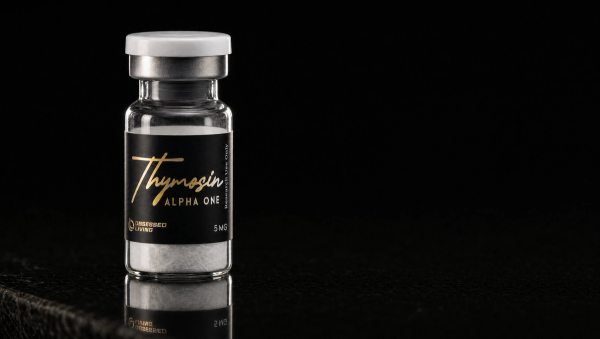
In a research setting, Thymosin Alpha-1 is typically supplied as a lyophilized (freeze-dried) powder for reconstitution and in-vitro or in-vivo investigation. It is supplied for laboratory research use only and is not for human consumption.
Pathways published research has investigated
Published research — spanning biochemical characterization, animal models, and a substantial body of human clinical trials — has investigated Thymosin Alpha-1 across several biological pathways. These are descriptions of what researchers have studied, not statements of effect in a person:
- Toll-like receptor (TLR) signaling in dendritic cells. Published reviews describe Tα1 as engaging TLR2, TLR3, TLR4, TLR7, and TLR9 on myeloid and plasmacytoid dendritic cells, triggering MyD88-dependent signaling and NF-κB activation that the literature links to downstream cytokine production [2, 5].
- Dendritic cell maturation and antigen presentation. Research describes Tα1 increasing dendritic cell expression of HLA class II antigens and phagocytic capacity, along with divergent cytokine output between dendritic cell subsets — IL-12p70 release from myeloid dendritic cells versus IL-10 production from plasmacytoid dendritic cells [5].
- T-cell maturation and Th1 cytokine production. Published studies describe Tα1 promoting differentiation of precursor T cells toward cytotoxic (CD8+) T lymphocytes and stimulating Th1-pattern cytokine output, including interferon-γ and interleukin-2 [2, 5].
- Cytokine cascade activation. Research describes downstream signaling (TRAF6/PKC/IKK/NF-κB and p38 MAPK/NF-κB pathways) associated with increased IL-6, IL-10, IL-12, TNF-α, and type I interferon production in the studied models [5].
The state of the literature
Thymosin Alpha-1 has one of the larger human clinical-trial records of any compound in this library, and the honest picture is a mixed one rather than a uniformly positive one.
Viral hepatitis. Multiple published trials have investigated Tα1 (as thymalfasin/Zadaxin) alone and combined with interferon-alpha in chronic hepatitis B and C, with published reviews describing favorable tolerability and, in some study populations, improved response rates over interferon alone [3, 4]. Thymalfasin/Zadaxin carries regulatory approval for hepatitis B and C in a number of countries outside the United States [3].
Sepsis. This is where the literature shows the clearest example of why the research register matters. An early multicenter randomized trial (ETASS) reported a favorable mortality signal for Tα1 in severe sepsis [6]. A 2025 systematic review and meta-analysis pooling 11 randomized controlled trials (1,927 patients) found an overall association between Tα1 and reduced 28-day mortality (odds ratio 0.73, 95% CI 0.59–0.90) — but when the analysis was restricted to only the highest-quality or only the multicenter trials, that benefit was no longer statistically significant, and the authors noted the pooled sample size remains inadequate for a firm conclusion [7]. A large 2025 multicenter trial (1,106 patients) found no significant mortality reduction overall, though it flagged possible benefit in elderly and diabetic subgroups [7]. This is exactly the kind of inconsistency a research-framed overview should surface rather than smooth over.
Oncology. Published research has investigated Tα1 as an adjunct to chemotherapy, interferon, and — more recently — immune checkpoint inhibitors, in contexts including melanoma and non-small-cell lung cancer, with studies describing immunomodulatory and antitumor activity in preclinical models [8]. This remains an active area of combination-therapy research rather than a settled clinical standard.
COVID-19. A registered clinical trial evaluated thymalfasin in COVID-19 infection; published results have been contested, with some studies reporting improved outcomes and others finding no significant mortality benefit after adjusting for confounding factors, with timing of administration flagged as a possible variable [5].
Regulatory status. Thymosin Alpha-1 is not an FDA-approved drug in the United States. The FDA has explicitly stated it has approved no drug products containing Tα1, and a 2024 FDA review of Tα1 as a candidate for the 503A compounding "bulks list" concluded the substance is not sufficiently characterized and that the balance of evidence weighed against adding it to that list — the nomination was withdrawn [9]. This is an important distinction from the peptide's approval status in some other countries, and it is why compliant discussion of Tα1 stays in the research register regardless of what the international literature shows.
How researchers handle it
In laboratory use, Thymosin Alpha-1 is reconstituted from lyophilized powder, commonly with bacteriostatic water, and handled under standard research conditions. Material supplied for research should carry a Certificate of Analysis confirming HPLC-verified purity so that what is being studied is well-characterized.
Go deeper
- Thymosin Alpha-1: mechanism of action in published studies — a closer look at the TLR, dendritic cell, and T-cell pathways above.
- Thymosin Alpha-1 vs Thymosin Beta-4 (TB-500): what the research compares — two very differently-named, very differently-studied thymic peptides.
- Thymosin Alpha-1 research FAQ — common questions, answered in a research context.
Research materials
Related compound: Thymosin Alpha-1 — supplied as research-grade lyophilized powder with Certificate of Analysis. Research use only. Not for human consumption.
The Obsessed Living Research Team summarizes peer-reviewed peptide research for educational, research-use reference. Content is not medical advice. Our research standards.